
A pool table room needs enough space for the table itself plus full cue clearance on all four sides. For a standard 8-foot home table with 58-inch cues, the minimum room size is 13’6″ × 17′. A room of 14′ × 18′ or larger provides a much more comfortable playing experience.
This guide covers exact room dimensions for every table size, design ideas by style and budget, lighting, flooring, furniture, dining room integration, and common mistakes to avoid. All dimension data is based on manufacturer specifications from Brunswick Billiards, Olhausen Billiards, and A.E. Schmidt, along with standards from the Billiard Congress of America (BCA) and the World Pool-Billiard Association (WPA).
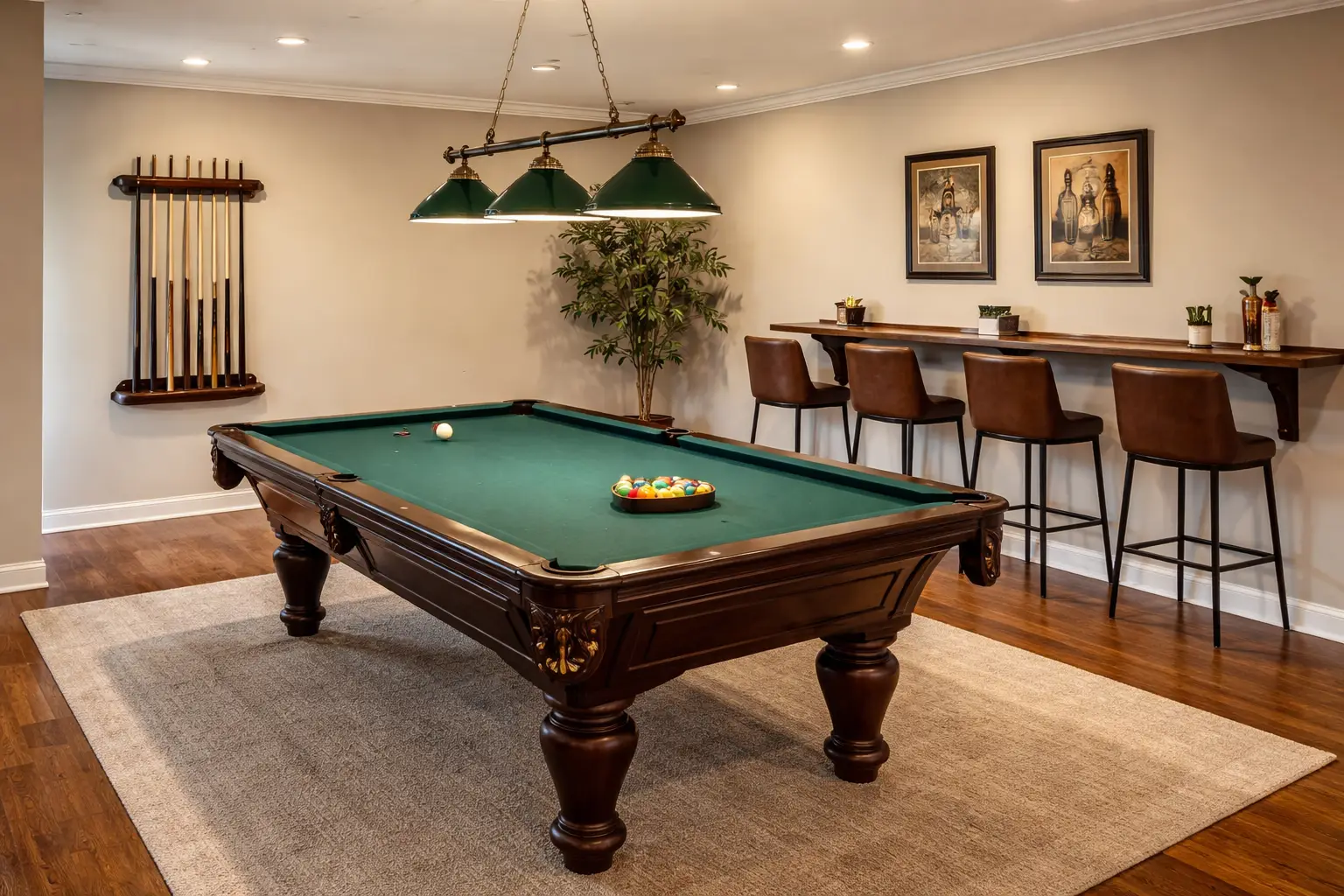
When manufacturers say “8-foot pool table,” they mean the playing surface the felted area inside the cushion rails, not the outer frame. A quick note on terminology: pool, billiards, and snooker are related but different cue sports. This guide covers standard American pocket billiard tables.
The 7-foot table (bar size) has a 39″ × 78″ playing surface with an outside frame of roughly 52″ × 91″. The 8-foot table (home size) the most popular choice in the US measures 44″ × 88″ inside the rails, with an outer frame around 57″ × 101″. The oversized 8-foot (Pro 8) sits at 46″ × 92″ inside with a 59″ × 105″ frame. The 9-foot table (tournament size) has a 50″ × 100″ playing surface and an outer frame of approximately 63″ × 113″.
All regulation tables follow a strict 2:1 ratio; the playing surface length is exactly twice the width. The 7-foot is standard in bars and used at BCAPL National Championships. The 9-foot is the official tournament standard used in the US Open and Mosconi Cup.
💡 Pro Tip: Always ask for inside playing surface dimensions when shopping not the outer frame size. Two tables marketed as “8-foot” can differ by several inches depending on rail design.
The formula every manufacturer uses:
Standard cues are 57–58 inches. Shorter 52-inch and 48-inch cues are available for tighter spaces.
|
Table Size |
With 58″ Cues | With 52″ Cues | With 48″ Cues | Best For |
| 7-foot | 13′ × 16′ | 12′ × 15′ | 11’6″ × 14’6″ | Small rooms, casual play, dens |
| 8-foot | 13’6″ × 17′ | 12’6″ × 16′ | 12′ × 15’6″ | Home game rooms (most popular) |
| Oversize 8-foot | 13’6″ × 17’6″ | 12’6″ × 16’6″ | 12′ × 16′ | Serious home players |
| 9-foot | 14′ × 18′ | 13′ × 17′ | 12’6″ × 16’6″ |
Tournament play, large rooms |
Quick rule of thumb: Add 5 feet to each side of the table, all the way around.
📌 Key Point: Switching from 58″ to 48″ cues reduces minimum room size by 1.5–2 feet in each direction often the difference between “doesn’t fit” and “fits perfectly.”
Not sure which table size is right for your space? Browse our pool table collection to find the perfect fit.
Step 1: Measure total length and width wall-to-wall in inches.
Step 2: Subtract permanent obstructions built-in shelving, radiators, door swings, fireplace mantles. This gives you open floor space.
Step 3: Subtract twice the cue length from both dimensions. The result is your maximum table size.
Step 4: Match results to the dimension chart above.
Step 5: Verify ceiling height you need at least 5 feet clearance above the table surface for jump shots and bridge shots. Standard 8-foot ceilings work fine.
Room: 16’8″ × 14′ (200″ × 168″). Using 58″ cues, subtract 116″ from each: 200 − 116 = 84″; 168 − 116 = 52″. A 7-foot table (39″ × 78″) fits perfectly. An 8-foot (44″ × 88″) one would be too long.
Related reading: How to Set Up a Pool Table
Most American basements have at least one support pole. Position it on a side of the table near the side pocket statistically the lowest-percentage shot. If it must be at the end, place it at the break end where the cue ball can be repositioned. Keep short cues (36″–48″) on hand for obstructed shots.
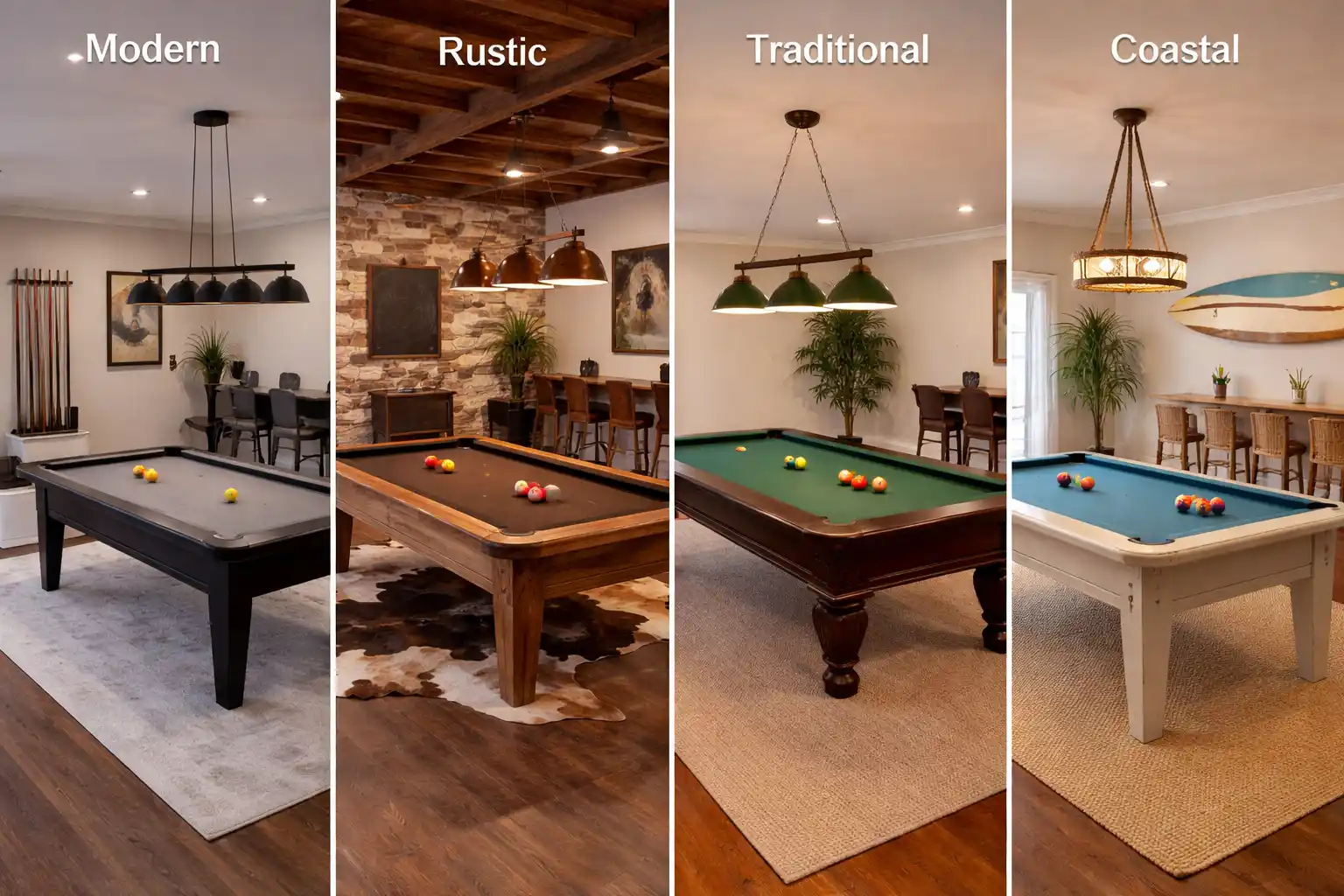
Hang a dedicated billiard light 30–36 inches above the playing surface. The BCA recommends 520 lux (48 footcandles) of even illumination. Choose a warm-to-neutral color temperature (3000K–4000K). Options include dedicated billiard lights, LED panels, track lighting, and recessed lights. Brands like Z-Lite specialize in pool table lighting. Install dimmers to switch between gameplay and social atmosphere.
Hardwood and luxury vinyl plank (LVP) are best: level, stable, and easy to clean. Avoid high-pile carpet. A slate pool table weighs 700–1,000+ lbs. If using an area rug, lay it before the table moving a slate table requires a full professional teardown and reassembly.
Keep the room at 65°F–75°F and 40%–60% relative humidity. High humidity warps wood and makes felt play slow. Low humidity cracks wood and hardens cushion rubber. Use a dehumidifier in basements, keep a consistent temperature year-round, and always use a fitted table cover.
Best seating: bar stools, pub-height chairs, storage ottomans, or wall-mounted fold-down chairs. Place a home bar along the short wall opposite the rack end. Use wall-mounted cue racks to save floor space or an under-table Legacy Perfect Drawer for cues, balls, brushes, chalk, and tip tools.
Essential checklist: Cue set (4 standard + 1 short), ball set (16 balls), triangle rack for 8-ball, diamond rack for 9-ball, chalk, brush, and table cover. Keep food and drinks away from the felt at all times.
Convertible pool-dining tables from brands like Vision Billiards, Spencer Marston, and Hathaway ($2,500–$15,000+) serve both functions with a removable hard top. Dining table top inserts for existing tables cost $200–$1,500+. Verify the playing surface uses real slate not MDF or Slatron (compressed particleboard with plastic laminate).
A budget setup runs $1,500–$3,500 and typically includes a 7-foot MDF table, a basic pendant light, and DIY wall decor using existing flooring. A mid-range room costs $3,500–$8,000 enough for an 8-foot slate table, a quality billiard light, new flooring, and a wall-mounted cue rack. Premium builds range from $8,000 to $15,000, covering a custom slate table, built-in bar, and designer furniture. For a luxury game room, expect $15,000–$40,000+, which includes a handcrafted table from makers like Brunswick or Olhausen, full room renovation, and a complete entertainment system.
Save money: Buy a used slate table and have it professionally refelted, use LVP instead of hardwood, and DIY your wall decor.
Ready to start? Explore our collection of tables, lighting, and accessories for every budget.
Minimum 13′ × 16′ with standard 58″ cues. With 48″ short cues, approximately 11’6″ × 14’6″.
Minimum 13’6″ × 17′ with standard cues. The most popular home table size in the US.
At least 5 feet (58 inches) of clearance from the table edge to the nearest wall on all four sides with standard cues.
Yes use a convertible pool-dining table or a removable dining-top insert.
Hardwood and luxury vinyl plank: level, stable, durable, easy to clean.
$1,500–$3,500 for a budget setup. $3,500–$8,000 for mid-range. $8,000–$40,000+ for premium and luxury.
Yes choose a 6 or 7-foot table with 48″ short cues. Fits in a room as small as 11’6″ × 14’6″.
Approximately 8 feet. Need 5 feet of clearance above the table surface for cue elevation and lighting.
Position it on a side of the table near the side pocket. Keep 48″ and 36″ short cues for obstructed shots.
The 8-foot table (44″ × 88″) is the most popular choice, balancing space requirements and authentic gameplay.