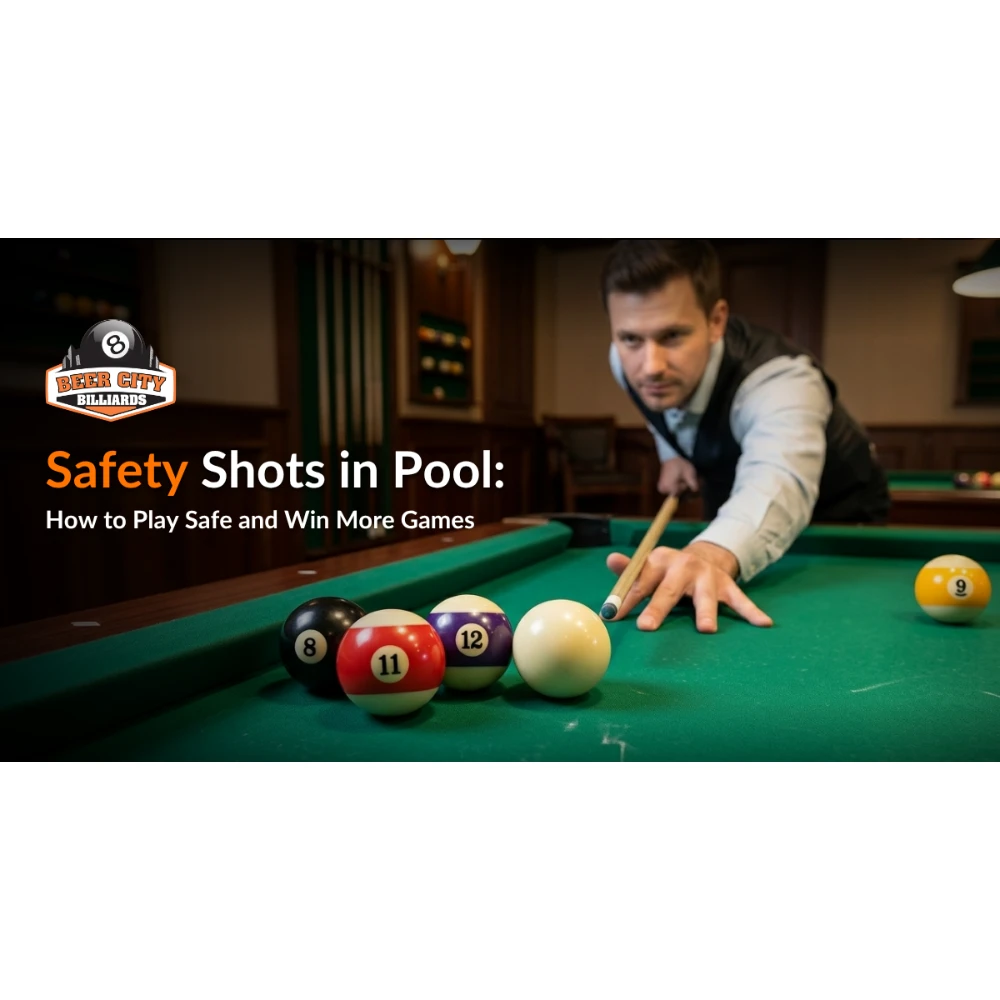
If you have been playing pool for a while, you probably know that sinking balls is only half the game. The other half is making sure your opponent never gets a clean look at the table. That is where safety shots in pool become your most powerful weapon.
Most casual players think that winning means potting ball after ball in impressive runs. But experienced players at every level will tell you the same thing: knowing when NOT to shoot is often the move that wins the game. Safety play in pool is a skill, a mindset, and once you develop it, your win rate goes up dramatically.
At Beer City Billiards, we see players of all skill levels walk through the door every day. The ones who improve the fastest are almost always the ones who start learning how to play defensively, not just offensively. This guide is going to walk you through everything you need to know about making safety shots work for you.
A safety shot in pool is any shot where your primary goal is not to pot a ball but to leave your opponent in a difficult or impossible position. Instead of going for a long, risky pot, you hit the cue ball in a way that either hides it behind one of your own balls, sends it to a tight area of the table, or leaves no clear angle for your opponent to make a productive shot.
This kind of thinking transforms how you see the game. Every shot becomes a decision point. You start asking yourself: “Can I pot this ball AND leave myself in a great position? If not, would it be smarter to play a safety?”
Safety play in pool is not passive. It is aggressive thinking with a long game perspective. You are not giving up on the rack. You are setting up the conditions that allow you to take over when the time is right.
The biggest obstacle for most players is mental. They feel like playing safe is admitting defeat or being boring. That thinking holds a lot of people back.
Here is the reality: the best pool players in the world play safeties constantly. Watch any professional nine ball or eight ball match and you will see both players trading safety shots back and forth until one of them makes a mistake. That is smart pool. That is tactical pool shots in action.
The mental shift you need to make is this: playing a safety is not avoiding the game. It is playing the game at a higher level. You are thinking two or three shots ahead instead of just reacting to what is in front of you.
When you start seeing safety shots as a tool rather than a last resort, your whole approach changes. You become harder to beat. You stop giving away frames on risky shots that do not need to be taken. And you start forcing YOUR opponents into those exact same situations.
You cannot play good safeties without cue ball control. This is the engine that makes everything else work.
Cue ball control means knowing where the cue ball is going after it contacts your object ball. It involves understanding how spin, speed, and angle all interact to produce a specific result on the table. When you master this, you can place the cue ball exactly where you want it after every shot, whether that is behind a cluster of balls, tight on a rail, or in the center of the table with no angle for your opponent.
Here are the key aspects of cue ball control to work on:
Speed control: One of the most common mistakes in safety play is hitting the cue ball too hard. Most defensive pool shots require a soft touch. A gentle roll to the rail, a slow nudge behind a cluster, a soft bump that leaves the cue ball frozen on the cushion. Practice hitting softly and with purpose.
Spin and english: Top spin, back spin, and side spin all dramatically change where the cue ball ends up. A stop shot, where you hit the cue ball with zero follow and it stops dead at impact, is one of the most useful tools in your safety arsenal. Practice center ball hits until they become second nature.
Angle awareness: Every contact between the cue ball and object ball creates a specific angle of deflection. Learn your natural angles off the cushion and off the object ball. Over time, this becomes intuitive and you will start seeing safety opportunities before you even approach the table.
Position play in pool is about planning. It is not enough to just play a safety that leaves the cue ball somewhere difficult. You need to think about what happens next and the shot after that.
Good position play means asking these questions every time you approach the table:
These questions become automatic the more you practice. You develop a feel for the table that allows you to see two or three exchanges ahead, which is exactly what separates good players from great ones.
One of the best exercises for developing position play is to spend time just moving the cue ball around the table without pocketing anything. Place balls in specific spots and practice leaving the cue ball in predetermined locations. Your touch will improve faster than you think.
There are several tried and tested safety techniques that apply across most pool games. Learning these gives you a toolkit to draw from in any situation.
The Stun Safety: You hit the object ball thin and use a stun shot to leave the cue ball in the middle of the table with no angle. Your opponent has a ball in front of them but no clean path to the pocket.
The Frozen Cue Ball Safety: You send the cue ball to a cushion with enough pace that it rolls up tight against a rail, leaving your opponent with no way to apply any spin or direction on their next shot.
The Ball Behind Safety: You drive the object ball to a safe spot while leaving the cue ball hidden behind one of your own balls or a neutral ball, forcing your opponent to kick or play a blind shot.
The Two Way Shot: This is the crown jewel of smart shot selection. You play a shot where you are genuinely trying to pot the ball, but the position you have set up means that even if you miss, the cue ball naturally rolls into a defensive position anyway. Two way shots are incredibly powerful because they take away the risk of aggressive play.
You can explore more of these techniques and see them demonstrated at the tables right here at Beer City Billiards. Our experienced staff love talking strategy with players who want to level up their game.
Smart shot selection is the combination of everything we have covered so far. It is the ability to look at the table, evaluate all your options, assign a rough probability and risk level to each one, and choose the shot that gives you the best overall outcome.
This is a skill that develops with experience, but there are frameworks that help speed up the learning process.
The risk vs. reward framework: Before every shot, ask yourself what happens if this goes wrong. A difficult cut into a corner pocket might look great if it goes in, but if it misses and leaves the cue ball in the middle of the table with your opponent having three easy balls, that risk is rarely worth taking. A safety might feel less exciting but it keeps you in control.
The percentage shot principle: Every shot has a rough percentage chance of going in based on the angle, distance, and your current skill level. Honest players know their own percentages. If you are only going to make a tough shot 30 percent of the time, and a safety in that spot would make things very difficult for your opponent, the safety is almost always the right play.
Pattern recognition: Over time you will start to recognize table patterns that call for safeties. Clusters that cannot be broken up productively, balls frozen on rails that make angles nearly impossible, layouts where your opponent’s balls are actually in positions that would benefit you if left alone. Recognizing these patterns early is what turns good players into sharks.
Safety play looks a little different depending on the game you are playing, so it is worth understanding the distinctions.
In eight ball, safeties often involve making it difficult for your opponent to hit their own balls cleanly. You can leave the cue ball near your own balls in a way that creates a partial snooker, or pot one of your own balls into a position where it blocks a key pocket for your opponent. Eight ball safeties tend to be more about controlling clusters and pocket access.
In nine ball, the dynamics are different because players must hit the lowest numbered ball first. This makes safeties more about hiding the cue ball from the one ball or leaving an angle on the one ball that produces a terrible result for the shooter. Nine ball safeties often involve thin contacts that send the cue ball to a far corner while the object ball hides somewhere awkward.
Both games reward the same underlying skills: cue ball control, position awareness, and smart shot selection. But the specific patterns and techniques differ enough that it is worth practicing both formats to develop a complete defensive game.
Knowing the theory is one thing. Building the muscle memory and pattern recognition that makes safety play instinctive takes dedicated practice to add to your routine.
The one ball safety drill: Place one ball on the table and practice sending the cue ball to different spots after contact. Start with center ball and add spin gradually. The goal is consistency. You should be able to hit the same shot five times in a row and end up within a chalk’s width of the same spot each time.
The cluster safety drill: Set up a cluster of balls near the center of the table and practice snookering yourself behind them. Then practice snookering your imaginary opponent. This builds your understanding of angles off ball clusters and helps you spot those opportunities in real games.
The two way shot drill: Set up scenarios where a ball is makeable but the natural miss position is also defensive. Practice both outcomes. Try to make the ball while also accepting that the miss is fine. This takes mental pressure off your attack game and makes you a much more dangerous player overall.
For anyone looking for a great place to practice all of this, Beer City Billiards has the tables, the atmosphere, and the community to help you sharpen every part of your game. Whether you are working on your cue ball control solo or playing competitive matches, you will find everything you need here.
Once you get good at safety shots in pool, something interesting happens. You start to notice how your opponents react to being put in difficult positions. Some players panic. Some get frustrated. Others become more careful and measured. All of these reactions give you information you can use.
A player who panics will often go for hero shots when they are snookered, giving you ball in hand or a free table repeatedly. Let them. A patient, careful player might play quality safeties back at you, which is where the real game within a game begins.
Learning to read what your opponent is likely to do next allows you to design your safeties more precisely. If you know a particular opponent always tries to kick two rails when snookered, you can set up safeties that punish exactly that type of response. This is tactical pool shots elevated to a psychological level and it is genuinely one of the most satisfying parts of the game when you get it right.
A guide on safety play would not be complete without acknowledging that you cannot play safe all the time. The goal is smart shot selection, not automatic conservatism.
Here are signs that an attacking shot is the right call:
The pot is genuinely high percentage and your natural position after the shot puts you in a strong spot for the next ball. Your opponent’s layout is wide open and leaving them in play would mean handing over a winning visit. You are in a position where playing safe does not actually create a meaningful problem for your opponent.
Here are signs that a safety is the right call:
The pot is risky and a miss leaves the cue ball in the open. Your opponent has several easy balls and getting to the table with ball in hand would basically hand them the frame. There is a natural safety that makes things very uncomfortable for your opponent at minimal risk to you.
The more you play, the more this decision becomes intuitive. But in the early stages of developing your tactical game, it helps to consciously ask yourself these questions before every shot.
Safety shots in pool are one of the most underrated tools in the game. Players who invest time in developing their safety play become significantly harder to beat and often more consistent than pure attacking players, because they stop giving away visits through reckless shot selection.
Cue ball control, position play in pool, smart shot selection, and reading your opponent are all skills that reinforce each other. Improving in one area lifts all the others. And the result is a more complete, more confident, and more successful pool player.
Whether you are a beginner finding your feet or an intermediate player looking for that next level, working on your defensive game will pay dividends faster than almost any other area of practice.
Come in to Beer City Billiards to practice and start putting these strategies to work on real tables with real opponents. The improvement you see will surprise you.