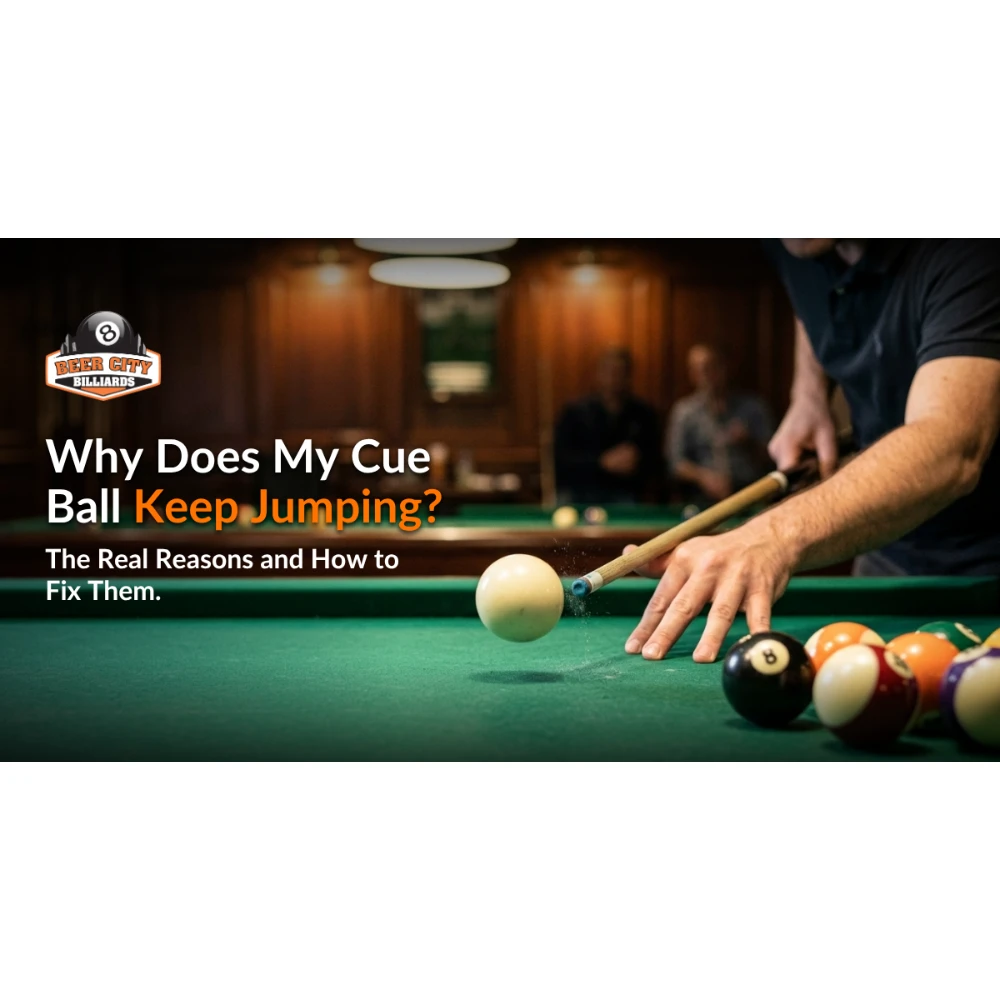
If you have ever been in the middle of a great game of pool and watched your cue ball leap off the table like it had somewhere else to be, you are not alone. Cue ball jumping is one of the most frustrating things a billiards player can experience, whether you are a weekend warrior at your local bar or someone who takes the game seriously. The good news is that this problem almost always comes down to technique, equipment, or a combination of both and every single one of those issues is fixable.
At Beer City Billiards, we talk to players every day who are dealing with this exact problem. So let us break it all down for you in plain language, no fluff, just real answers that will help you keep that cue ball rolling smoothly across the felt where it belongs.
Before we get into the fixes, it helps to understand what is actually happening when your cue ball leaves the table surface. When the cue ball jumps, it means the cue tip made contact with the ball at a downward angle sharp enough to push the ball into the table surface, which then causes it to bounce upward. In controlled situations, players actually use this technique intentionally to perform a jump shot. But when it happens accidentally during a normal shot, it usually means something in your mechanics has gone wrong.
There are several root causes behind unintentional cue ball jumping. Let us walk through the most common ones.
This is the number one culprit behind accidental cue ball jumping. When you elevate the back of your cue too high, even by just a few degrees more than necessary, you are directing your stroke downward into the table rather than through the ball horizontally. The moment that cue tip drives the ball down into the cloth, physics takes over and the ball bounces up.
For most standard shots, your cue should be nearly parallel to the table. A slight elevation is fine and sometimes necessary, especially when you are shooting over another ball. But the general rule is to keep your cue as level as possible. If you are consistently finding your cue ball jumping, check your bridge position and your shooting stance. Often the cue is elevated simply because the bridge hand is too high off the table.
Lowering your bridge so your hand sits flat and your cue rests closer to the table surface will immediately reduce that downward angle and stop the accidental jumping in its tracks.
Hitting low on the cue ball is a legitimate technique used to apply backspin. However, when you combine a low hit with even a slight downward stroke, the results can be dramatic. The tip makes contact beneath the ball’s equator and the downward energy sends the ball right into the cloth and then up into the air.
If you are trying to apply draw or backspin, make sure your cue remains level when executing the shot. The lower your contact point on the cue ball, the more careful you need to be about keeping your stroke flat and smooth. Rushed strokes and tense arms only make this worse.
Your bridge is the foundation of every shot you take. A shaky, inconsistent bridge leads to all kinds of problems, and cue ball jumping is one of them. When your bridge is too loose or too elevated, the cue tip can wobble or dip slightly at the moment of contact, causing that unwanted downward impact on the ball.
A solid closed bridge or a firm open bridge, depending on your preference and the shot, gives you control and consistency. If your bridge hand is lifting off the table or shifting during your stroke, work on anchoring it more firmly before you pull back and shoot. For newer players especially, practicing the bridge alone before combining it with a full stroke can make a noticeable difference almost immediately.
You can find quality cues and accessories designed for better control right here at Beer City Billiards Pool Cues and Equipment, where we carry options that suit every playing style and skill level.
A miscue happens when the tip of your cue does not make clean, centered contact with the cue ball. This often causes the tip to glance off the surface of the ball at an angle, which can send the cue ball jumping or spinning in an unintended direction. Miscues are usually caused by using a cue tip that has not been properly maintained, or by using a tip that has hardened and lost its chalk retention.
Chalk is essential. Before every shot, you should be chalking your tip lightly to ensure proper grip between the tip and the cue ball. Skipping this step dramatically increases your chances of a miscue, which in turn increases your chances of sending the cue ball airborne. Also, regularly scuff your tip with a tip tool to keep it properly shaped and porous enough to hold chalk.
Pool is a game that rewards patience, and nothing exposes a rushed stroke quite like an unintentional jump shot. When players hurry through their shot, the backswing shortens, the follow through suffers, and the stroke often drops at the moment of contact. That drop is exactly what causes the cue ball to dig into the felt and bounce.
Developing a slow, deliberate practice stroke before committing to the shot is one of the most effective habits you can build. Take two or three practice strokes to feel the line, then pause briefly at the back of your final backswing before delivering a smooth, level follow through. That brief pause eliminates the tendency to rush and gives your body time to reset before the actual stroke.
Sometimes the problem is not entirely about your technique. Older tables with uneven rails, worn or warped slate, or damaged cloth can create dead spots that cause the cue ball to respond unpredictably. A bump or ridge in the felt can catch the cue ball and send it skyward even on a well-executed shot.
If you notice the jumping happens consistently in the same spot on the table, the table itself may be the issue rather than your form. Playing on a properly maintained table is one of the best investments you can make in your game. If you are looking for quality billiard tables for your home or establishment, our selection at Beer City Billiards Pool Table services includes professionally leveled and felt options that give you a consistent, true playing surface every time.
Not all cues are built for all shots. Standard cues work perfectly for regular play, but they are not designed for jump shots. Jump cues are shorter, lighter, and have a harder tip that allows players to execute intentional jump shots with proper technique. If you are picking up your regular playing cue and trying to force it into a jump shot situation, you may find the cue ball behaving erratically.
Conversely, if you are using a cue that is too flexible or too light for your natural stroke weight, your shots may lack control and produce unintended ball behavior. Matching the right cue to your game is something our staff genuinely loves helping customers figure out. Stop by or browse our cue selection at Beer City Billiards Cue Shop and let us point you toward options that fit how you actually play.
If you have identified one or more of the issues above as the cause of your cue ball jumping, the fix comes through deliberate, focused practice. Here are some drills that specifically address this issue.
The Level Cue Drill: Place a coin or a small flat object on top of the cue ball and practice your stroke slowly without knocking it off. This immediately tells you whether your cue is staying level through contact.
The Ghost Ball Drill: Set up a shot without a target ball and focus entirely on the cue ball. Watch it after contact. Does it roll smoothly or does it skip? Smooth rolling means your stroke is level and clean.
The Slow Motion Stroke Drill: Remove all power from your stroke and focus only on hitting the cue ball with a perfectly level tip at whatever contact point you choose. Do this repeatedly until the mechanics feel automatic before adding speed back in.
Cue ball jumping is a correctable problem. Once you understand the mechanical reasons behind it, the path forward becomes clear. Whether it is adjusting your bridge height, slowing down your stroke, chalking your tip before every shot, or investing in better equipment, every step you take toward fixing the root cause is a step toward a more consistent and enjoyable game.
The cue ball is the most important ball on the table. How you control it defines everything about your game. When you commit to understanding it better and practicing the fundamentals with intention, you will be amazed at how quickly your play improves.
At Beer City Billiards, we are here to support your game at every level. From equipment to advice, we love this sport and we love helping players like you get better at it.