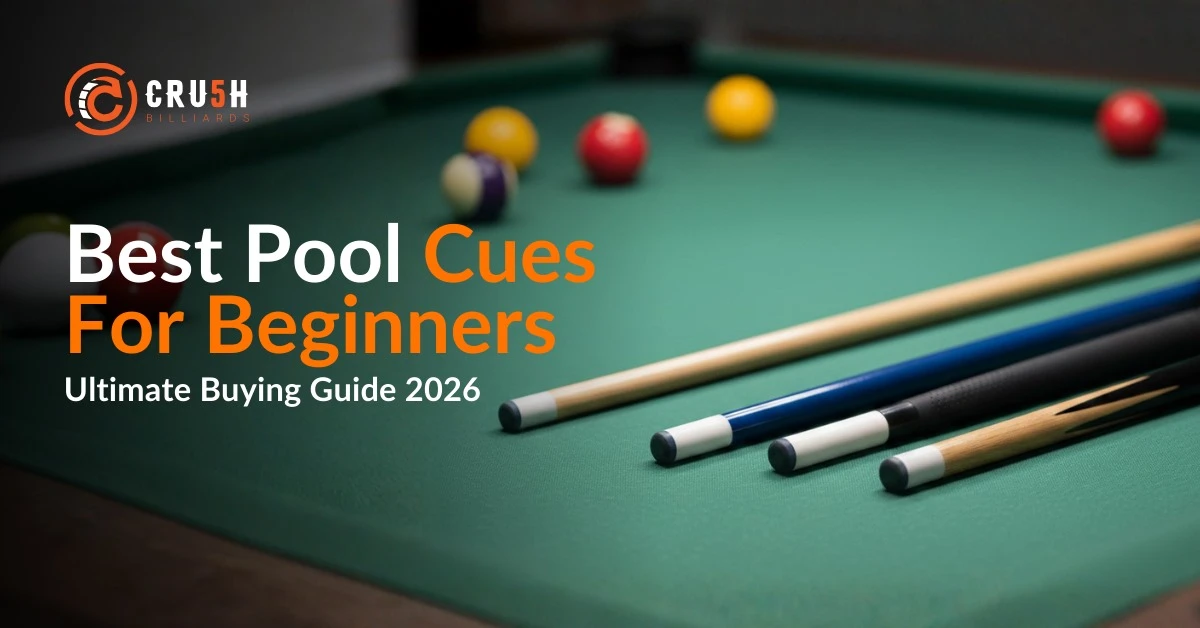
Are you tired of using bent, worn-out house cues at your local pool hall? You’re not alone!
Here’s the truth. A good pool cue changes everything. It helps you aim better. It makes your shots smoother. And it builds your confidence at the table.
But here’s the problem. There are hundreds of cues out there. Different weights. Different tips. Different prices. It’s confusing!
That’s why we created this guide.
At Beer City Billiards, we’ve helped thousands of beginners find their perfect first cue. We know what works. We know what doesn’t. And we’re sharing everything with you today.
In this guide, you’ll learn:
Let’s find your perfect beginner pool cue!
In a hurry? Here are our top picks:
| Rank | Pool Cue | Price | Best For |
|---|---|---|---|
| 🥇 #1 Best Overall | Players C-960 | ~$90 | Most beginners |
| 🥈 #2 Best Budget | Scorpion JAR01 | ~$45 | Tight budgets |
| 🥉 #3 Best Premium | Lucasi Custom LZC34 | ~$175 | Serious beginners |
Players C-960 wins for most people. Why? It has everything a beginner needs. Good weight. Nice tip. Smooth shaft. And it won’t break the bank.
Scorpion JAR01 is our budget champion. It costs less than $50. But it plays like cues twice the price. Perfect if you’re just starting out.
Lucasi Custom LZC34 is for serious beginners. You play every week. You want a cue that lasts for years. This is it.
Want to see all our picks? Keep reading!
👉 Shop All Beginner Pool Cues at Beer City Billiards
Before we show you our top picks, let’s learn the basics. Don’t worry. We’ll keep it simple!
What is cue weight?
It’s how heavy your pool cue feels in your hands. Pool cues usually weigh between 17 and 21 ounces.
What weight is best for beginners?
19 to 20 ounces. This is the sweet spot.
Here’s why:
Think of it like this:
A 19-20 oz cue is like a comfortable backpack. Not too heavy. Not too light. Just right for carrying all day.
Quick Tip: Most beginners do best with 19 oz. It’s the most popular weight for a reason!
How long is a pool cue?
Most pool cues are 57 to 58 inches long. This is called “standard length.”
Do you need a different size?
Probably not! Standard length works for most people.
Here’s a simple guide:
| Your Height | Recommended Cue Length |
|---|---|
| Under 5’2″ | 52″ – 55″ (shorter cue) |
| 5’2″ to 6’2″ | 57″ – 58″ (standard) |
| Over 6’2″ | 58″ – 61″ (longer cue) |
Good news: If you’re between 5’2″ and 6’2″, standard length is perfect. That’s most people!
What is tip size?
It’s how wide the leather tip is at the end of your cue. Tips are measured in millimeters (mm).
What size is best for beginners?
12.75mm to 13mm. This range is perfect for new players.
Why larger tips help beginners:
Think of it like this. A larger tip is like a bigger baseball bat. It’s easier to hit the ball!
Our recommendation: Start with a 13mm tip. You can go smaller later when your skills improve.
Pool cue tips come in three types:
1. Soft Tips
2. Medium Tips ⭐ (Recommended)
3. Hard Tips
Our recommendation: Choose medium hardness. It’s the easiest to use and maintain.
The shaft is the long, skinny part of the cue. It’s what you slide through your fingers when you shoot.
Three main materials:
1. Maple Wood ⭐ (Recommended for Beginners)
2. Fiberglass
3. Carbon Fiber
Our recommendation: Go with maple. It’s what most players use. It feels great. And it won’t cost a fortune.
The wrap is the grip area where you hold the cue.
Three main types:
1. Irish Linen ⭐ (Most Popular)
2. Leather
3. Wrapless (No Wrap)
Which should you choose?
| If You Have… | Choose This Wrap |
|---|---|
| Normal hands | Irish Linen |
| Sweaty hands | Leather |
| Dry hands | Wrapless |
| Not sure | Irish Linen |
Our recommendation: Start with Irish linen. It works for almost everyone.
This one is simple!
1-Piece Cues:
2-Piece Cues: ⭐ (Recommended)
Quick Comparison:
| Feature | 1-Piece | 2-Piece |
|---|---|---|
| Portability | ❌ Poor | ✅ Excellent |
| Storage | ❌ Difficult | ✅ Easy |
| Travel | ❌ Impossible | ✅ No problem |
| Price | ✅ Cheaper | Good value |
| Quality | Good | ✅ Great |
Our recommendation: Get a 2-piece cue. You can take it to pool halls, friends’ houses, and tournaments. It’s the only practical choice.
The joint is where the two pieces connect.
Don’t stress about this! For beginners, joint type doesn’t matter much.
Common types:
What matters: That the joint is solid and doesn’t wobble.
Our advice: Focus on weight, tip, and material first. Joint type matters more for advanced players.
Now let’s look at our top picks! We organised them by price so you can find the perfect cue for YOUR budget.
Starting on a tight budget? No problem! These cues prove you don’t need to spend a lot to get started.
Price: ~$45
Why We Love It:
The Scorpion JAR01 is amazing for the price. Seriously. It plays like cues that cost twice as much.
Specifications:
Pros:
Cons:
Best For: First-time buyers who want quality without spending much.
Our Verdict: “If you’re not sure about pool yet, start here. This cue won’t disappoint.”
Price: ~$40
Why We Love It:
Players is a trusted brand. They make reliable, affordable cues. The D-JS is one of their best entry-level options.
Specifications:
Pros:
Cons:
Best For: Beginners who want a reliable brand without overspending.
Our Verdict: “A solid choice from a brand that’s been making cues for decades.”
Price: ~$49
Why We Love It:
Cuetec cues are tough. Like, really tough. The fiberglass coating protects the wood from moisture, warping, and dings.
Specifications:
Pros:
Cons:
Best For: Players in humid areas or those who are rough on their equipment.
Our Verdict: “Built like a tank. Great if durability is your top priority.”
Who should buy under $50:
What to expect:
Upgrade timeline: When you’re playing weekly and want better performance.
This is our most recommended price range!
Why? You get significantly better quality. Better materials. Better tips. Better feel. These cues will last for years.
Price: ~$90
Why We Love It:
This is THE cue we recommend most. It has everything a beginner needs at a price that makes sense.
Specifications:
Pros:
Cons:
Best For: Any beginner who wants the best value.
Why This Cue Stands Out:
The Kamui tip alone is worth $25-30. You’re basically getting a premium tip for free! This tip grips the cue ball beautifully. It makes spin shots easier to learn.
Our Verdict: “If you buy one cue from this list, make it this one. Best value in the beginner market.”
Price: ~$95
Why We Love It:
Lucasi makes beautiful cues. The L-E10 has a classic look that never goes out of style. But it’s not just pretty—it plays great too.
Specifications:
Pros:
Cons:
Best For: Players who appreciate classic aesthetics and reliable performance.
Our Verdict: “A beautiful cue that plays as good as it looks.”
Price: ~$85
Why We Love It:
McDermott is an American company that makes quality cues. The Lucky L1 is their entry-level model, but don’t let that fool you—it’s built to last.
Specifications:
Pros:
Cons:
Best For: Players who want American quality and a lifetime warranty.
Our Verdict: “Buy once, play forever. The McDermott warranty is legendary.”
Price: ~$75
Why We Love It:
Viking is known for making durable, high-performance cues. The Valhalla VA101 brings their quality to the beginner market.
Specifications:
Pros:
Cons:
Best For: Players who want brand-name quality on a budget.
Our Verdict: “Viking quality at an entry-level price. Hard to beat.”
At this price range, you get:
| Feature | Under $50 | $75-$100 |
|---|---|---|
| Tip Quality | Basic | Premium |
| Shaft | Good | Excellent |
| Warranty | 1 year | Lifetime (many) |
| Feel | Decent | Great |
| Durability | Good | Excellent |
| Resale Value | Low | Moderate |
Our advice: If you can afford it, spend $75-$100. Your cue will play better. It will last longer. And you won’t need to upgrade as soon.
Ready to invest a bit more? These cues offer premium features that help you improve faster.
Price: ~$130
Why We Love It:
This cue has low-deflection technology. What does that mean? Your shots go where you aim them—even with spin!
Specifications:
Pros:
Cons:
Best For: Beginners ready to learn spin shots and bank shots.
Our Verdict: “Worth every penny if you’re serious about improving.”
Price: ~$140
Why We Love It:
Poison makes some of the most innovative cues on the market. Arsenic brings its technology to a beginner-friendly price.
Specifications:
Pros:
Cons:
Best For: Players who want modern technology and a bold look.
Our Verdict: “High-tech performance at a reasonable price.”
These cues are for serious beginners. You know you love pool. You want the best start possible.
Price: ~$175
Why We Love It:
This cue has features found in $300+ cues. It’s an incredible value for serious players.
Specifications:
Pros:
Cons:
Best For: Serious beginners who want a cue they’ll use for years.
Our Verdict: “The best cue on this list. Period. Worth every penny.”
Price: ~$220
Why We Love It:
Predator is the #1 name in professional pool. Their P3 series brings pro-level performance to ambitious beginners.
Specifications:
Pros:
Cons:
Best For: Players who want the best and plan to compete.
Our Verdict: “If budget allows, this cue will take you from beginner to advanced.”
Honest answer: It depends.
YES if:
NO if:
Our advice: Start with the $75-$100 range. If you’re still playing after 6 months, then consider upgrading.
Here’s everything side by side:
| Cue Name | Price | Weight | Tip Size | Material | Wrap | Best For | Our Rating |
|---|---|---|---|---|---|---|---|
| Scorpion JAR01 | $45 | 19oz | 13mm | Maple | Linen | Budget buyers | ⭐⭐⭐⭐ |
| Players D-JS | $40 | 18-21oz | 13mm | Maple | Linen | Casual starters | ⭐⭐⭐⭐ |
| Cuetec R360 | $49 | 19-21oz | 13mm | Coated maple | Linen | Durability | ⭐⭐⭐⭐ |
| Players C-960 | $90 | 18-21oz | 12.75mm | Maple | Linen | Best overall | ⭐⭐⭐⭐⭐ |
| Lucasi L-E10 | $95 | 18-21oz | 12.75mm | Maple | Linen | Classic style | ⭐⭐⭐⭐½ |
| McDermott L1 | $85 | 19oz | 13mm | Maple | Linen | USA quality | ⭐⭐⭐⭐½ |
| Viking VA101 | $75 | 18-21oz | 13mm | Maple | Linen | Brand quality | ⭐⭐⭐⭐ |
| Lucasi LZ2004 | $130 | 18-21oz | 11.75mm | Slim maple | Linen | Serious players | ⭐⭐⭐⭐½ |
| Poison Arsenic | $140 | 18-21oz | 12.75mm | Venom² | Leather | Modern tech | ⭐⭐⭐⭐½ |
| Lucasi LZC34 | $175 | 18-21oz | 11.75mm | Zero Flex | Leather | Premium pick | ⭐⭐⭐⭐⭐ |
| Predator P3 | $220 | 19oz | 12.9mm | 314-3 | Linen | Elite players | ⭐⭐⭐⭐⭐ |
Let’s learn about the top brands you can trust.
Who They Are: Players has been making affordable, quality cues for over 20 years.
Why Good for Beginners:
Price Range: $40 – $200
Our Take: “Best bang for your buck in the beginner market.”
Who They Are: Lucasi is known for beautiful designs and innovative technology.
Why Good for Beginners:
Price Range: $80 – $400
Our Take: “When you want looks AND performance.”
Who They Are: Cuetec pioneered the fiberglass-coated cue for ultimate durability.
Why Good for Beginners:
Price Range: $50 – $300
Our Take: “Built to survive anything.”
Who They Are: American-made cues with legendary lifetime warranties.
Why Good for Beginners:
Price Range: $85 – $1000+
Our Take: “Buy once, play forever.”
Who They Are: Viking has been making quality cues since 1965.
Why Good for Beginners:
Price Range: $75 – $500
Our Take: “Trusted quality for decades.”
Who They Are: Budget-friendly brand that doesn’t sacrifice quality.
Why Good for Beginners:
Price Range: $35 – $100
Our Take: “Best choice for tight budgets.”
Learn from others’ mistakes! Here’s what to avoid.
The Problem:
We get it. Money is tight. But that $15 cue from the discount store? It’s going to hurt your game.
Why It’s Bad:
Better Approach:
Save a little longer and spend at least $40-50. The jump in quality is HUGE. You’ll actually enjoy playing.
The Problem:
Many beginners just grab any cue without checking the weight.
Why It’s Bad:
Better Approach:
Try different weights before buying. Most people like 19-20 oz. But you might be different!
The Problem:
Hard tips are cheaper. But they’re harder to use!
Why It’s Bad:
Better Approach:
Choose medium hardness. It’s forgiving and helps you learn.
The Problem:
You buy online without ever holding the cue.
Why It’s Bad:
Better Approach:
If possible, visit a local shop first. Test different cues. Then buy your favorite (online is fine once you know what you want).
The Problem:
You buy a nice cue… then throw it in your car trunk.
Why It’s Bad:
Better Approach:
Budget for a case too! Even a $20 soft case protects your investment.
The Problem:
That skull-and-flames design looks AWESOME! But how does it play?
Why It’s Bad:
Better Approach:
Performance first. Looks second. A plain cue that plays great beats a pretty cue that plays terribly.
The Problem:
You buy a $300 cue as a complete beginner.
Why It’s Bad:
Better Approach:
Start with $75-$100. Play for 6 months. Then upgrade if you’re still loving it.
The Problem:
You don’t check if there’s a warranty.
Why It’s Bad:
Better Approach:
Buy from brands with good warranties. McDermott has LIFETIME warranty. Most quality brands offer at least 1 year.
The Problem:
You buy a cue with no room to grow.
Why It’s Bad:
Better Approach:
Consider brands that let you upgrade the shaft later. Or buy slightly better quality now so it lasts longer.
Still wondering if you need your own cue? Let’s compare!
| Factor | House Cue | Your Own Cue |
|---|---|---|
| Weight | Random every time | Always the same ✅ |
| Tip Condition | Usually worn/damaged | Well-maintained ✅ |
| Straightness | Often warped | Guaranteed straight ✅ |
| Length | No choice | Your preference ✅ |
| Comfort | Hit or miss | Perfect for you ✅ |
| Confidence | Low | High ✅ |
| Improvement | Slow | Fast ✅ |
| Consistency | Zero | 100% ✅ |
Imagine learning basketball with a different ball every time. Sometimes it’s flat. Sometimes it’s over-inflated. Sometimes it’s too big. How would you improve?
That’s what house cues are like!
With YOUR cue:
This consistency is how you improve quickly.
Want to make sure you’re getting a good cue? Here’s how to test it!
What to Do:
What to Look For:
Why It Matters:
A bent cue won’t shoot straight. Period. Always roll test before buying!
What to Do:
What to Look For:
Why It Matters:
A well-balanced cue feels natural in your hands. Bad balance feels awkward.
What to Do:
What to Look For:
Why It Matters:
You’ll be holding this cue for hours. It needs to feel right!
What to Do:
What to Look For:
What to Do:
What to Look For:
Why It Matters:
The shaft slides through your bridge hand on every shot. It needs to be smooth!
Your cue is just the start! Here’s what else you need.
Why You Need It:
Your cue is an investment. Protect it!
Types:
| Type | Protection | Price | Best For |
|---|---|---|---|
| Soft Case | Basic | $15-30 | Light travel |
| Hard Tube | Good | $30-50 | Regular travel |
| Box Case | Excellent | $50-100+ | Serious players |
Our Recommendation:
Start with a basic soft case ($15-25). Upgrade later if needed.
Why You Need It:
Chalk helps your tip grip the cue ball. Without it, you’ll miscue (slip off the ball).
How to Use:
Chalk before EVERY shot. Light, even coating. Don’t grind it!
Recommendation:
Master chalk is great for beginners. Kamui chalk is premium but expensive.
What It Does:
Roughens your tip so it holds chalk better.
Why You Need It:
Smooth tips don’t hold chalk. No chalk = miscues.
Recommendation:
Simple tip pick or scuffer. $5-10. Use it every few sessions.
What It Does:
Cleans dirt and oils off your shaft.
Why You Need It:
Dirty shafts don’t slide smoothly through your bridge hand.
Recommendation:
Basic cue cleaner and a microfiber cloth. Use monthly.
What It Does:
Makes the shaft slide smoothly through your bridge hand.
Who Needs It:
Who Doesn’t Need It:
Take care of your cue and it’ll take care of you!
How Often: Every 2-4 weeks (or when it feels sticky)
What You Need:
Steps:
Don’t:
Do:
Don’t:
Shaping:
Your tip should be round like a nickel. Use a tip shaper to maintain this shape.
Scuffing:
Rough up the tip every few sessions so it holds chalk.
When to Replace:
What is it?
The white piece between the shaft and the tip.
How to Protect:
❌ Don’t leave your cue in a hot car
❌ Don’t store in direct sunlight
❌ Don’t use household cleaners
❌ Don’t ignore tip maintenance
❌ Don’t drop or bang your cue
❌ Don’t let others use it without permission
You’ve been playing for a while. Is it time for a better cue?
Skill Signs:
Feel Signs:
✅ You can run 3+ balls consistently
✅ You understand basic position play
✅ You can make simple spin shots
✅ You’ve been playing 6+ months
✅ You play at least weekly
✅ You’ve identified weaknesses in your game
From Budget ($40-50) → Move to mid-range ($75-100)
From Mid-Range ($75-100) → Move to intermediate ($150-300)
From Intermediate ($150-300) → Move to advanced ($300-600)
Pro Tip: You can often just upgrade the SHAFT and keep your butt. This saves money!
Let’s compare your options.
Pros:
Cons:
Our Pick: Beer City Billiards (that’s us!)
We’re real billiard experts. We’ve been helping players find the perfect cue for years. And we stand behind everything we sell.
Pros:
Cons:
Pros:
Cons:
Our Take: Amazon is fine for some things. Pool cues aren’t one of them. You need expert guidance for your first cue.
✅ Real Expertise: We’re actual billiard players and experts
✅ Huge Selection: All major brands in one place
✅ Best Prices: Competitive with anyone
✅ Real Support: Questions? We answer them!
✅ Quality Guaranteed: We don’t sell junk
✅ Fast Shipping: Get your cue quickly
Answer: 19-20 oz works best for most beginners.
This weight range gives you good control without being too heavy. Start at 19 oz. If shots feel weak, try 20 oz. If the cue feels heavy, try 18.5 oz.
The key is consistency. Once you find your weight, stick with it!
Answer: We recommend $75-$150 for serious beginners.
Here’s the breakdown:
Most players are happiest in the $75-$100 range.
Answer: 2-piece is better for almost everyone.
Why? Portability! A 2-piece cue breaks down for easy carrying. You can take it to pool halls, friends’ houses, and tournaments.
1-piece cues are only good if you ONLY play at home and never travel with your cue.
Answer: 12.75mm to 13mm is ideal for beginners.
Larger tips are more forgiving. They give you a bigger “sweet spot” when hitting the cue ball. This means fewer miscues and more consistent shots.
Once your skills improve, you can try smaller tips (11.75mm-12mm) for more spin control.
Answer: The best beginner-friendly brands are:
You can’t go wrong with any of these!
Answer: Generally, no.
Here’s why:
However, spending $75-100 IS worth it versus $25-40. The jump in quality is noticeable even for beginners.
Answer: Mostly yes!
Same cue works for:
Different cue needed for:
Most beginners just need one cue for common American pool games.
Answer: 3-5+ years with proper care.
Lifespan depends on:
A $90 cue that’s well-maintained will outlast a $200 cue that’s abused!
Answer: Main differences:
| Feature | Cheap ($20-40) | Mid-Range ($75-150) | Expensive ($300+) |
|---|---|---|---|
| Wood Quality | Low-grade | Good maple | Premium maple |
| Tip | Basic | Quality brand | Professional |
| Straightness | May warp | Stable | Guaranteed |
| Balance | Poor | Good | Excellent |
| Feel | Rough | Smooth | Buttery |
| Warranty | None/short | 1 year+ | Lifetime often |
| Longevity | 1-2 years | 3-5 years | 10+ years |
Answer: Neither—use medium weight (19-20 oz).
Lighter cues (17-18 oz):
Heavier cues (20-21 oz):
Medium (19-20 oz):
Answer: No, not yet.
Break cues are for intermediate/advanced players. They’re designed specifically for the opening break shot.
As a beginner:
Answer: Check these things:
Good Signs:
Bad Signs:
After all that information, here’s the simple answer:
| Your Situation | Our Recommendation | Price |
|---|---|---|
| Tight budget, just starting | Scorpion JAR01 | ~$45 |
| Best value for most beginners ⭐ | Players C-960 | ~$90 |
| Want American quality | McDermott Lucky L1 | ~$85 |
| Serious about improving | Lucasi LZ2004 | ~$130 |
| Want the best available | Lucasi Custom LZC34 | ~$175 |
For most beginners, we recommend the Players C-960.
Why?
You really can’t go wrong with this cue.
Shop our complete beginner cue collection at Beer City Billiards!
We have:
Still not sure which cue is right for you?
Contact us! Our team has helped thousands of beginners find their perfect cue. We’re happy to answer questions and make personalised recommendations.
We’re not just another online store. We’re real billiard enthusiasts who love helping people discover this amazing game.
Why trust us?
Thank you for reading our complete guide to the best pool cues for beginners. Now go sink some balls!