If your cue ball is stopping short off the cushion instead of bouncing back with authority, you are not imagining things. Dead rails on a pool table are one of the most common complaints we hear from home owners, bar operators, and league players alike, and the frustrating part is that most people do not notice the problem until it has already been affecting their game for months. A ball that used to rebound crisply now thuds against the cushion and drops dead, throwing off position play and making even simple bank shots feel like guesswork.
In this guide we will walk through exactly what causes pool table dead rails, how to test for the problem yourself, and what your realistic options are once you have confirmed it. Whether you are dealing with a table that gets heavy weekend use at a bar, or a table sitting quietly in a basement that has not been touched in years, the underlying causes tend to be surprisingly consistent.
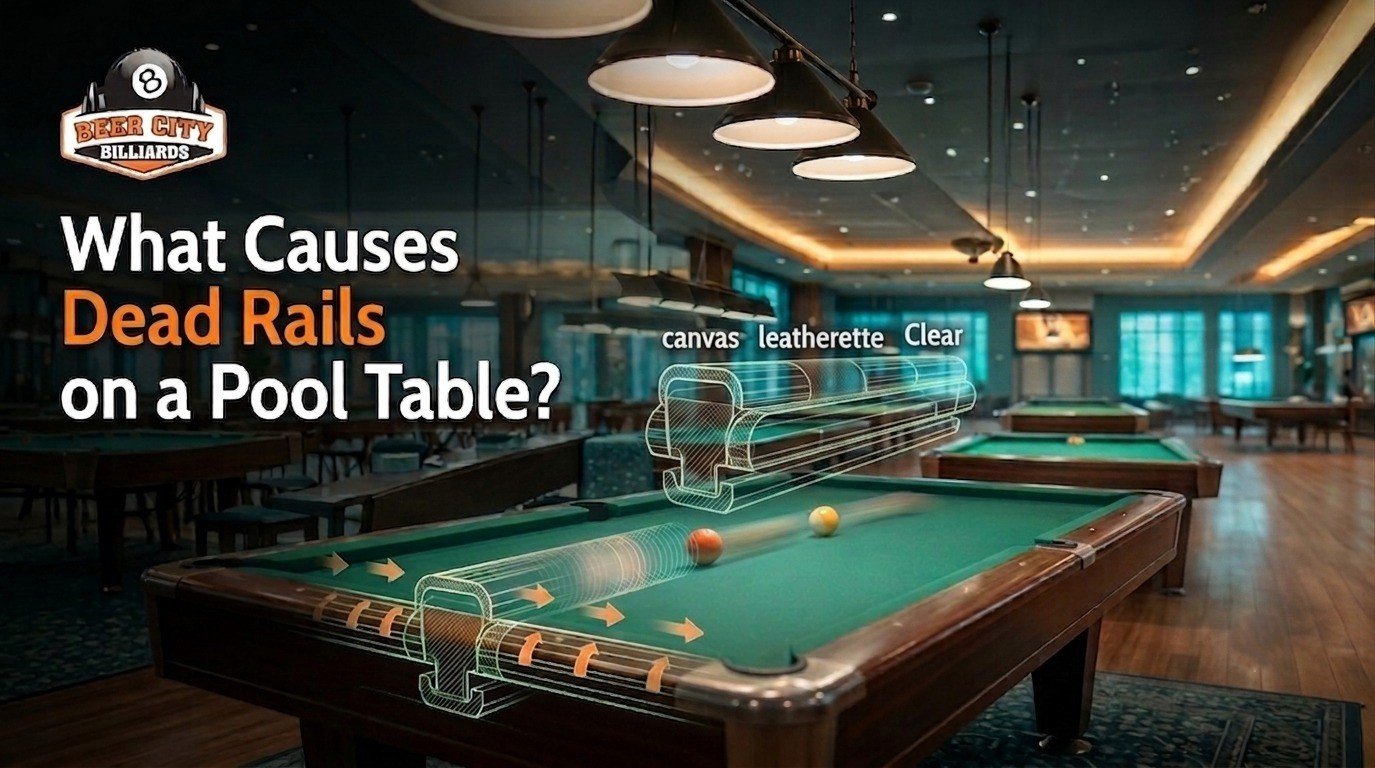
Every pool table rail is built around a strip of cushion rubber that runs along the inside edge of the wooden rail. When a ball strikes that rubber, the rubber compresses and then springs back, sending the ball off at an angle with roughly the same energy it arrived with. That spring back action is what players call rail responsiveness.
A dead rail is a cushion that has lost that spring back quality. Instead of returning the ball’s energy, the rubber absorbs it. The ball either barely creeps off the rail, or it comes off at a strange angle because one section of the cushion is behaving differently than the rest. Dead pool table rails do not usually fail all at once. The decline tends to be gradual, which is exactly why so many players adjust their game unconsciously long before they realize the equipment is the problem rather than their stroke.
Cushion rubber is a natural or synthetic compound, and like any rubber product it degrades over time. Rail rubber replacement eventually becomes necessary on every table because the compound oxidizes as it sits exposed to air and light. Oxidized rubber becomes stiff on the outside while sometimes staying soft underneath, or it can go the opposite direction and turn spongy all the way through. Either way, the elasticity that makes a cushion bounce properly is gone.
Most quality cushions, including popular options like K66 cushions and K55 cushions, are rated to perform well for a decade or more under normal conditions. Heavily used commercial tables in bars and pool halls often see noticeably shortened lifespans simply because of the sheer number of impacts the rubber absorbs every week.
Rubber is sensitive to its environment, and pool table cushions are no exception. A table kept in a garage, basement, or any space without climate control experiences constant expansion and contraction as temperatures and humidity levels shift with the seasons. Over time this repeated stress breaks down the internal structure of the cushion rubber faster than steady, climate controlled conditions would.
Humidity in particular is a sneaky culprit. Damp air can be absorbed into the rubber and the wood backing behind it, softening the cushion and reducing rail responsiveness. Dry conditions, on the other hand, tend to make rubber brittle and prone to cracking near the nose of the cushion where the ball actually makes contact.
Direct sunlight is genuinely rough on cushion rubber. Ultraviolet light accelerates the same oxidation process that happens naturally over time, just much faster. A table positioned near a window that gets afternoon sun can develop dead spots on one side of the table years before the rest of the rails show any wear. If you have ever noticed that one rail seems noticeably deader than the others, sun exposure is worth investigating as a cause.
Not every rail problem traces back to age. Sometimes a cushion was never installed correctly in the first place. Cushion rubber has to sit at a very specific height and angle relative to the bed of the table, generally measured against the equator of the ball, so that energy transfers correctly on impact. If a previous repair job used the wrong cushion profile, mounted the rubber at the wrong height, or used substandard adhesive, the rail can feel dead or inconsistent even though the rubber itself is relatively new.
This is one of the reasons pool table rail repair is best handled by someone with real experience rather than a generic handyman. Getting the geometry wrong during a repair can actually make bounce worse than it was before the fix.
Cushion rubber is typically stapled to the rail using a facing strip, and that facing has to stay tight against the wood for the rail to transfer energy properly. Over years of impacts, staples can work themselves loose, the wood underneath can shrink slightly, or the facing strip itself can warp. When the cushion is not held firmly and snugly in place, part of the ball’s energy gets lost as the whole assembly flexes instead of the rubber alone doing the work. This produces a mushy, dead feeling rail even if the rubber compound is technically still in decent shape.
Chalk dust, spilled drinks, hand oils, and general grime build up on cushions over the life of a table, especially on tables that see bar or commercial use. This residue is not just a cosmetic issue. A layer of buildup on the cushion nose changes how the ball contacts the rubber and can make the rail feel sticky or inconsistent, which is sometimes mistaken for a dead rail when really it is a maintenance issue. Regular pool table maintenance including wiping down the rails helps rule this out before assuming a bigger repair is needed.
Worn pool table rails are simply a fact of life on tables that get frequent use. Every impact compresses the cushion rubber slightly, and repeated compression over thousands of games gradually reduces the rubber’s ability to snap back. Tables in busy bars, pool halls, and community centers often need cushion attention far sooner than a table that sees occasional casual play at home. If your table is used often, treat rail wear as routine maintenance rather than a surprise repair.
Sometimes what feels like a dead rail is actually a leveling problem. If the slate underneath is not level, or the frame has shifted slightly, balls can behave strangely near the rails in ways that mimic poor bounce. Table leveling should always be checked before committing to a full rail replacement, since it is a much simpler and cheaper fix if leveling turns out to be the real issue.
Before assuming the worst, you can run a simple test at home. Place a ball roughly six inches from a rail and shoot it straight into the cushion with light to moderate speed, then measure how far it rebounds compared to the distance it traveled going in. Do this at multiple points along each rail, including near the pockets and near the middle, since dead spots are often localized rather than spread evenly across the whole cushion.
Compare the rebound distance rail by rail. If one or two rails clearly underperform the others, you likely have isolated dead spots caused by sun exposure, a bad repair, or localized wear. If every rail on the table performs poorly and consistently, aging cushion rubber across the board is the more likely explanation. Either way, this simple bounce test tells you a lot about pool table performance before you call anyone out for a professional opinion.
If contaminants turn out to be the culprit, a thorough cleaning with the correct cushion safe products can restore a surprising amount of bounce. This is the cheapest fix and worth ruling out first.
When the rubber itself has aged out, pool table cushion repair typically means removing the old rubber facing and installing new strips, most commonly K66 cushions or K55 cushions depending on the table brand and desired play speed. K66 is the more common choice on modern tables and tends to offer a slightly faster, more consistent bounce, while K55 is often found on older tables and can feel a touch softer. A qualified technician will match the replacement to your table’s original specifications and complete proper rail calibration afterward so that every cushion performs consistently.
In cases where the wood rail itself is damaged, warped, or was poorly built to begin with, pool table rail replacement of the entire rail assembly may be the more sensible long term option rather than repeatedly patching cushion rubber onto a compromised base.
Since rail work already requires partial disassembly in many cases, this is often a smart time to consider fresh pool table cloth as well, particularly if the felt is showing pilling, stains, or thinning near the pockets. Doing both at once saves on labor compared to two separate service visits.
Cue ball rebound depends on precise geometry, the right cushion rubber profile for your specific table brand, correct adhesive application, and careful rail calibration once everything is reinstalled. Get any one of those details wrong and you can end up with rails that look fine but still play inconsistently. This is genuinely detailed work, closer to a craft than a simple parts swap.
If you are in Michigan and want an expert set of eyes on your table, our team offers professional pool table service covering everything from cushion rubber replacement to full rail rebuilds and cloth installation. We are happy to inspect your table, run the same rebound tests described above, and give you a straightforward recommendation rather than pushing an unnecessary full rebuild when a smaller repair will do the job.
A little routine pool table maintenance goes a long way toward protecting rail responsiveness over the years:
Good pool ball maintenance matters here too. Dirty or damaged balls transfer grime onto the cushions with every shot, quietly speeding up the same wear pattern that leads to dead rails down the road. Keeping your balls clean protects both your rails and your cloth at the same time.
How long do pool table cushions typically last? Most billiard table rails with quality cushion rubber last somewhere between eight and fifteen years under normal use, though heavy commercial use, poor climate conditions, or sun exposure can shorten that considerably.
Can I fix dead rails myself? Cleaning and minor tightening are reasonable do it yourself tasks. Actual cushion rubber replacement, however, requires precise measurements, the correct materials, and careful calibration, which is why most players choose professional pool table repair for anything beyond basic cleaning.
Is K66 better than K55 for cushion replacement? Neither is strictly better, they simply play differently. K66 cushions tend to offer a livelier, slightly faster response and are the modern standard on many tables, while K55 cushions provide a softer feel that some players and older table designs are specifically built around.
Does one dead rail mean all four need replacing? Not necessarily. Localized dead spots, especially near a window or a heavily used section of the table, can sometimes be repaired individually. A full inspection will tell you whether the whole set needs attention or just the affected section.
Will new felt fix a dead rail problem? No, cloth and cushions are separate systems. Fresh pool table cloth improves roll and ball speed across the bed of the table, but it will not restore bounce if the cushion rubber underneath the rail is the actual problem.
Dead rails on a pool table rarely show up overnight, which is exactly why so many players spend months adjusting their game around a problem that has a straightforward fix. Whether the cause turns out to be aging rubber, sun exposure, humidity swings, a shoddy previous repair, or simple wear from heavy use, identifying the actual root cause is the key step before spending money on service.
If you have run the bounce test above and confirmed your rails are underperforming, do not wait for the problem to get worse. Browse our shop for cushion-safe cleaning supplies and accessories, explore more billiards tips and maintenance guides on our blog, or contact our team to schedule a professional inspection. Getting your rails back to full responsiveness is usually a much smaller job than most people expect, and it can make a bigger difference to your game than almost any other type of equipment maintenance.