
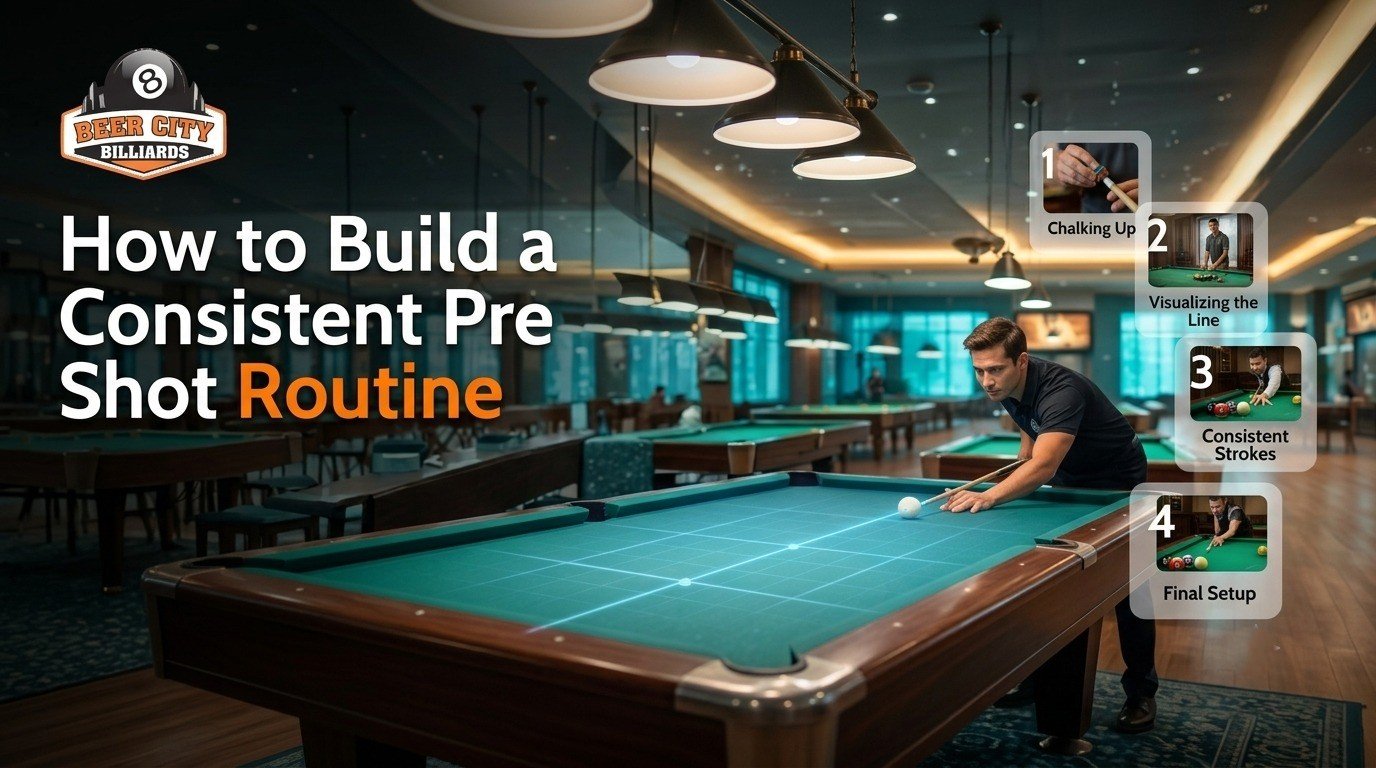
Watch any professional pool player step up to a shot and you will notice something interesting. Before they even touch the cue to the ball, they go through a series of small, almost identical movements every single time. They walk into the shot the same way, set their bridge hand the same way, take the same number of practice strokes, and pause at the same point before pulling the trigger. This is not superstition or habit for the sake of habit. It is a pre shot routine, and it is one of the most underrated skills in the entire game.
Most amateur players spend countless hours working on their stroke mechanics, their stance, and their aim, but very few spend any real time developing a structured pre shot routine. That is a mistake, because a consistent routine is often the missing link between knowing how to play and actually performing well under pressure.
This guide breaks down exactly what a pre shot routine is, why it matters so much for shot consistency, and how to build one that works for your game from the ground up.
A pre shot routine in pool is the consistent sequence of physical and mental steps a player goes through before every single shot, regardless of the difficulty or the situation. It begins the moment you start reading the table and ends the instant you release the cue ball.
A good pool pre shot routine typically includes reading the shot, selecting your target, walking into your stance, setting your bridge hand, aligning your cue, taking a set number of warm up strokes, pausing briefly, and then executing the stroke. Every single time, in the same order, with the same rhythm.
The goal is not to make every shot feel mechanical or robotic. The goal is to remove variability from everything except the actual stroke itself. When your routine becomes automatic, your mind is free to focus entirely on the one thing that actually matters in that moment, which is pocketing the ball and controlling the cue ball afterward.
It is tempting to think that talent, practice hours, or natural feel for the game are what separate good players from great ones. Those things matter, but consistency at the table is often the real differentiator, and a pre shot routine is the foundation that consistency is built on.
Every shot in pool involves dozens of small decisions. How hard should you hit it. Where exactly is your target point. How much english do you need. Where do you want the cue ball to end up. If you are making all of these decisions fresh every single time with no structure, your mind becomes cluttered and overloaded, especially under pressure.
A routine handles the mechanical decisions automatically, freeing up mental bandwidth for the decisions that actually require thought, like shot selection and position play.
Your stance, your bridge hand, your stroke mechanics, all of these physical elements improve dramatically when they are repeated in the exact same way shot after shot. Inconsistent setup leads to inconsistent results, even if your fundamentals are technically sound. A pre shot routine locks in the same physical setup every time, which allows your muscle memory to actually do its job.
Anyone who has played in a league match or a tournament knows the feeling of nerves creeping in during a crucial shot. A well rehearsed routine acts as an anchor in those moments. When everything else feels uncertain, falling back into your familiar sequence of steps gives your mind something stable to hold onto, and that stability translates directly into better execution.
When your routine is consistent, it becomes much easier to diagnose what went wrong after a missed shot. If your setup and process are different every time, you have no reliable baseline to compare against. A consistent routine means that when you miss, you can isolate whether it was your alignment, your stroke, or your read of the shot, rather than wondering if the entire process was simply random that time.
Building a pre shot routine from scratch can feel overwhelming, so it helps to break it down into its essential building blocks. Most strong routines include the following stages, performed in the same order every time.
Before you even approach the table, take a moment to fully assess the shot. Identify your pocketing angle, consider where you want the cue ball to travel after contact, and think through any obstacles like other balls in the way. This is the strategic phase of your routine, and it should happen before you settle into your stance.
Many players benefit from walking around the table slightly to view the shot from a couple of angles before committing. This is especially useful on shots with subtle cut angles that are hard to judge from a single vantage point.
Once you understand the shot, identify your precise target, whether that is a ghost ball position or ball line aiming reference point. Visualize the path of the cue ball both into the object ball and after contact. This mental rehearsal step is often skipped by amateur players, but professionals rely on it heavily because it primes the brain and body for the exact action that follows.
Approach the shot from a consistent angle every time, ideally walking in along the same line that your cue will eventually travel. This helps your body naturally align with the shot rather than forcing an adjustment after you have already settled into position.
Your stance should be stable, balanced, and repeatable. Many instructors recommend a slightly staggered foot position with your dominant side foot back, providing a stable base that supports a smooth pendulum like stroke. If your stance shifts from shot to shot, your alignment will shift too, even if your aim feels correct in the moment.
Your bridge hand is the foundation that guides your cue through the stroke, and it deserves just as much consistency as your stance. Whether you use an open bridge or closed bridge, place your hand at a consistent distance from the cue ball, generally around six to eight inches depending on your comfort and the shot at hand.
A wobbly or inconsistent bridge hand introduces lateral movement into your stroke that can throw off your aim even when everything else is correct. Practicing your bridge hand placement in isolation, away from full shots, can dramatically improve your overall consistency.
This is where most of your pre shot routine time is spent. Settle your cue along your intended line, checking that your grip, forearm, and cue tip are all tracking straight through your target line. Take a consistent number of practice strokes, commonly between two and five depending on personal preference, allowing your stroke to find its natural rhythm before you commit to the shot.
During these practice strokes, your eyes should move smoothly between the cue ball and the target, confirming your alignment with each pass. This is often called the final look phase, and it is one of the most important habits a player can build. Many players miss the importance of where their eyes settle just before the stroke begins, but research and instruction in the sport consistently point to a still, focused final look at the target as a key factor in consistent pocketing.
Right before you begin your final stroke, build in a small, deliberate pause. This moment allows your mind to fully commit to the shot and prevents rushed, last second decision making that often leads to mishits. This pause does not need to be long, often less than a second, but it should be a consistent part of your routine every single time.
Finally, execute your stroke smoothly and with commitment. By this point in your routine, all of the thinking and decision making should already be complete. The execution phase should feel almost automatic, a natural release of the stroke you have already rehearsed mentally and physically through your practice swings.
There is no single correct duration for a pre shot routine, and the right length depends heavily on personal preference and playing style. Some elite players move through their routine in under ten seconds, while others take closer to twenty or thirty seconds on more difficult shots.
What matters far more than the actual time is the consistency of that time. If your routine takes twelve seconds on an easy shot and forty five seconds on a difficult one, you are likely overthinking the harder shots and rushing the easier ones, both of which introduce inconsistency.
A helpful exercise is to time yourself across a practice session and notice your natural rhythm. Once you identify a comfortable pace, work on holding that same pace regardless of shot difficulty. This consistency is often more valuable for shot consistency than the specific routine elements themselves.
It is a strange but common pattern among amateur players to rush through routines on shots that intimidate them, almost as if getting it over with quickly will reduce the pressure. In reality, this almost always leads to worse outcomes. Difficult shots deserve the same careful routine as easy ones, if not slightly more deliberate attention.
When nerves set in during a match, many players unconsciously skip steps in their routine, particularly practice strokes and the final pause. This is exactly the wrong instinct, since pressure situations are precisely when a reliable routine matters most. Recognizing this tendency in yourself is the first step toward correcting it.
A pre shot routine exists to complete all of your thinking before the stroke begins. If you find yourself still calculating speed, spin, or angle during your actual stroke, your routine has broken down somewhere earlier in the sequence. All analytical thinking should be finished by the time you take your final look and begin your pause.
Some players vary their practice stroke count dramatically from shot to shot without realizing it, taking two strokes on one shot and seven on the next. This inconsistency disrupts the rhythm that a routine is meant to build. Pick a number that feels natural, generally between two and five strokes, and stick with it across all shot types.
Set up a simple straight in shot and practice your entire routine slowly, step by step, without actually hitting the ball at first. Walk in, set your stance, place your bridge hand, align your cue, take practice strokes, pause, and then stop. Repeat this several times to build awareness of each phase before adding the actual shot back in.
During a practice session, count your practice strokes on every shot for an entire session. Notice any patterns, particularly whether your count changes based on shot difficulty or pressure. Awareness alone often leads to natural correction over time.
Set up a moderately difficult shot and tell yourself this is for the match, simulating the mental pressure of a real game situation. Run through your full routine and notice whether any steps get rushed or skipped compared to how you perform the same shot in a relaxed practice setting.
Recording yourself during practice, even with a phone propped against a chair, is one of the most effective ways to see whether your routine is actually as consistent as it feels. Watch your stance, bridge hand placement, and practice stroke count across multiple shots and compare them side by side.
Building these drills into your regular pool practice routine accelerates the process of making your pre shot sequence feel natural and automatic rather than forced.
A consistent pre shot routine does more than help you pocket balls. It directly improves your cue ball control, which is arguably the more important skill for advancing in the game. When your setup is consistent shot after shot, your stroke delivers more predictable speed and spin, which means the cue ball travels to more predictable places after contact.
Inconsistent setups often lead to inconsistent stroke delivery, even when a player has good technical knowledge of speed and spin. A wobbly bridge hand or rushed alignment can introduce unintended spin or speed variation that throws off your position play even on shots you pocket successfully.
If you are working on improving your cue ball control and overall consistency, explore the Beer City Billiards Blog for more expert tips on shot making, position play, and improving your game.
A pre shot routine is not purely physical. It is also a mental tool that builds confidence over time. When you trust your routine, you stop second guessing your setup and alignment in the moment, which allows you to commit fully to your stroke.
This confidence compounds over time. Players who trust their pre shot routine tend to perform more consistently under pressure because they are relying on a rehearsed process rather than trying to make perfect decisions on the fly during a stressful match. The routine becomes a form of mental focus training, training your mind to settle into the same calm, prepared state before every shot regardless of the stakes.
While consistency is the goal, a good pre shot routine should still flex slightly to accommodate different shot demands without abandoning its core structure.
On straightforward shots, your routine should move through its steps at your normal pace without rushing simply because the shot feels easy. On more complex shots involving significant cut angles, position play considerations, or safety situations, you may naturally spend a bit more time in the reading and visualization phase, but your physical setup steps, including stance, bridge hand, and practice stroke count, should remain consistent.
The key distinction is that variation in thinking time is acceptable and even necessary, but variation in physical execution steps undermines the entire purpose of having a routine in the first place.
Developing a consistent pre shot routine is one of the most valuable investments you can make in your overall game. It is not flashy, it will not show up in highlight reels, and it requires patience to build properly, but the payoff shows up in every single session you play from that point forward.
Start by identifying the core steps that work for your game, including how you read a shot, set your stance, place your bridge hand, align your cue, and settle into your practice strokes. Practice these steps deliberately and slowly at first, then gradually allow them to become automatic through repetition.
Pay close attention to moments of pressure, whether in friendly games or competitive matches, since these are the situations where your routine is most likely to break down and also where it matters most. Use drills specifically designed to reinforce consistency, and consider recording yourself periodically to catch habits you may not notice in the moment.
Pool fundamentals like stance, grip, and stroke mechanics will always matter, but a pre shot routine is the framework that ties all of those fundamentals together into something repeatable and reliable. Build yours with intention, and you will likely notice improvements in your shot consistency long before you notice changes in your technical skill alone.
If you are looking to take your practice sessions to the next level with structured drills and a full training plan, our complete pool practice routine guide offers a structured approach to building both your fundamentals and your consistency at the table.