
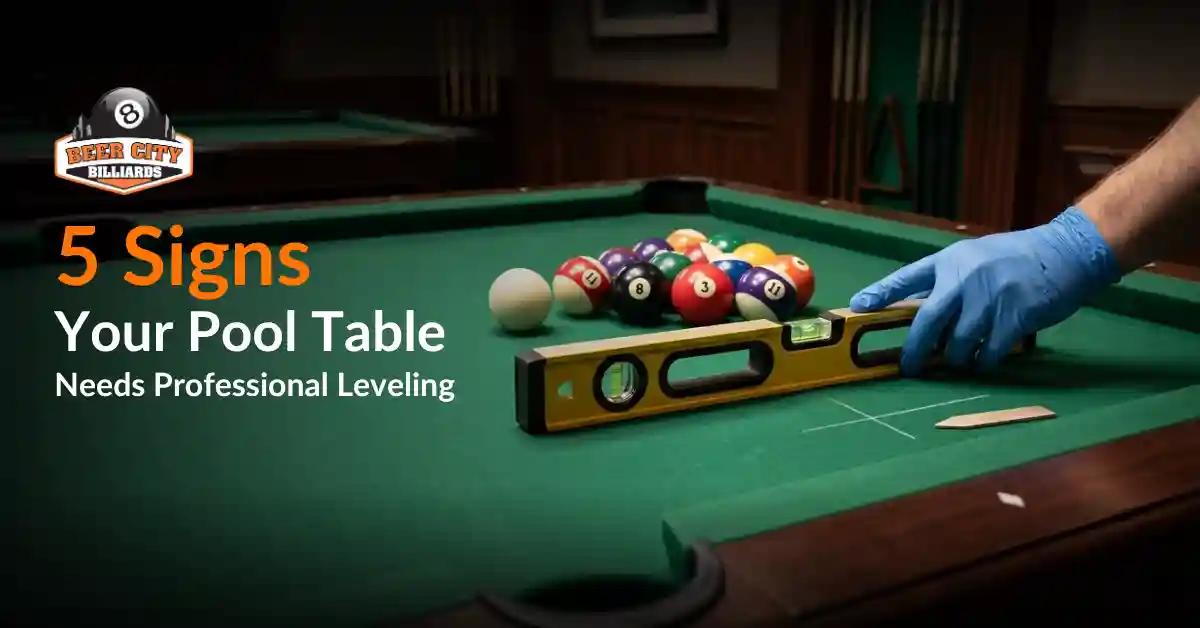
If you own a pool table, you already know that the quality of your game depends on far more than just skill and a good cue. The surface beneath the felt is everything. An unlevel table turns even the cleanest shots into frustrating misses, and the worst part is that most players do not realize their table is the problem. They just keep blaming themselves.
Pool table leveling is one of the most overlooked aspects of table maintenance, yet it is one of the most critical. Whether your table is sitting in a basement, a bar, or a dedicated game room, the ground beneath it shifts, the legs settle, and the slate can warp over time. These changes happen gradually, which is exactly why they go unnoticed for so long.
In this guide, we are going to walk you through the five most telling signs that your pool table is crying out for professional leveling. By the end, you will know exactly what to look for and what to do about it. If you are also in the process of setting up a new table, make sure to check out our
In this guide, we are going to walk you through the five most telling signs that your pool table is crying out for professional leveling. By the end, you will know exactly what to look for and what to do about it. If you are also in the process of setting up a new table, make sure to check out our Pool Table Setup Guide (2026) for a complete walkthrough on getting things right from the start.
This is the most obvious and common red flag. Place a ball at the center of the table and let it sit. If it starts rolling on its own, your table is not level. Now, a tiny drift might seem harmless, but during a game it completely changes the behavior of every shot you take.
When a ball you have stopped mid table begins moving toward one rail without any force applied, the surface is tilted. Even a tilt of just a few millimeters across the length of a standard 8 foot table is enough to cause this. If the ball rolls to a corner pocket consistently, that corner of the table is lower than the rest.
This issue becomes even more apparent with long shots and positional play. You might line up what looks like a perfect cut shot, only to find the cue ball drifting wide at the end. That is not a technique flaw. That is your floor doing the work.
The fix requires a professional with the right tools. Shimming legs or adjusting the feet on a slate table needs precision, and doing it incorrectly can cause uneven pressure on the slate itself, which leads to cracking over time. Getting it right the first time is always the smarter move.
You know your table well. You have played the same long straight shot down the center dozens of times. But lately, the ball keeps curving or drifting slightly, and you cannot figure out why. You check your stance. You check your stroke. Everything looks right. But the ball still goes off line.
The culprit is often a table that has an uneven playing surface, not just from front to back, but from side to side. Lateral unevenness is trickier to spot with the naked eye but has a massive impact on your game. A ball rolling across a surface that slopes left or right will always curve in that direction, no matter how straight your shot is.
This kind of problem gets worse near the rails. If you are playing a shot that hugs the cushion, the ball might glide cleanly for the first two feet and then suddenly veer inward. That is the slope of the table pulling it away from a perfectly vertical rail.
At Beer City Billiards, we see this type of complaint frequently from players who have moved their tables to a new room or a new home. Even carrying a table across a hallway can knock the feet out of alignment. And if your home settles seasonally due to temperature and humidity changes, the table needs to be checked and releveled regularly.
Take a close look at the felt on your pool table. Run your hand across it slowly from one end to the other. Do you notice areas that feel more compressed, more worn, or that look a slightly different shade than the rest? That uneven wear is telling you something important.
When a table is not level, balls tend to travel through certain areas more frequently than others. The lowest points on the table naturally attract more ball traffic, which means the felt in those areas takes more friction and wears down faster. You might also notice that the chalk dust and residue accumulates more heavily in certain zones, which is another giveaway.
Uneven felt wear is not just a cosmetic issue. It actually changes how the ball behaves in different parts of the table. A ball rolling through a worn patch will move faster because there is less resistance. A ball rolling through a thick, undamaged area will slow slightly. This inconsistency makes accurate positional play nearly impossible.
If you are noticing felt wear alongside other signs of leveling issues, it might also be a good time to think about a full table service. You can learn more about what that involves by visiting our Table Repairing Service page, where our Michigan based team handles everything from refelting to full slate realignment.
Here is a simple test that reveals a lot about the condition of your table. Take the cue ball and place it in five different locations: the center, both diamond points on the long rail, and both ends near the head and foot spots. Hit each one with the same stroke at the same angle and observe carefully.
On a properly leveled table, the cue ball should behave consistently no matter where it starts. The spin, the travel distance, and the rebound angles should all follow predictable physics. But if you notice that shots from one end of the table behave noticeably differently from the other end, you are dealing with a level problem.
This test is particularly useful for competitive players who rely on consistent cue ball control for positional play. If you are getting solid contact but the cue ball is not ending up where you planned, the table might be the reason. Many skilled players have gone weeks thinking their position game has broken down, only to discover the table was the culprit all along.
This inconsistency is particularly pronounced on three piece slate tables where the individual sections may have shifted slightly. A proper leveling service includes checking and adjusting each slate section and ensuring the seams are flush before any shimming is done at the base.
Even if you have not noticed any of the physical signs above, there are situational red flags that should prompt you to schedule a professional pool table leveling service. The biggest one is movement.
Anytime a pool table is moved, whether it is across the room, to a new home, or even just lifted to change the flooring underneath, the leveling is disrupted. A slate pool table weighs hundreds of pounds, and the feet, legs, and slate sections all shift during transport. Even when the table looks perfectly square and stable after reassembly, the internal geometry may be off in ways that only a level and professional tools can reveal.
Tables that have sat unused for extended periods also need to be checked. Seasonal changes in temperature and humidity cause wood to expand and contract. In basements and garages, moisture can cause the legs to compress unevenly. In rooms without climate control, this happens every single year without you noticing.
If you recently put your table together and want to make sure everything was assembled correctly from the ground up, our step by step guide on How to Put a Pool Table Together walks you through the full process and highlights the most common mistakes people make during reassembly that lead to leveling problems later on.
You might be wondering whether pool table leveling is something you can do yourself. And yes, there are guides online that walk you through using a carpenter’s level and adjusting the leg bolts. But there is a significant difference between a table that looks level and a table that plays level.
A carpenter’s level placed on the felt surface only measures one plane at a time. Professionals use precision machinist levels and often take measurements across the slate itself, at multiple points, in multiple directions. The accuracy required for a tournament quality roll is far beyond what a standard level can achieve.
Beyond accuracy, there is the question of the slate itself. Three piece slate tables require that each section be leveled independently and then aligned with each other. The seams between sections need to be flush to within a fraction of a millimeter. Getting this wrong can cause a ball to jump or deflect at the seam, which is not only annoying but impossible to correct through any amount of skill development.
Professional leveling also involves checking the frame of the table for warping, inspecting the condition of the cushion bolts and rail alignment, and ensuring the legs are distributing weight evenly across all four points. It is a comprehensive service that protects your investment and restores the quality of your game in a way that a quick DIY adjustment simply cannot match.
For home tables that do not get moved, having the table professionally leveled once a year is a reasonable maintenance schedule. If the room experiences significant seasonal temperature changes, twice per year is better.
For commercial settings like bars, pool halls, and recreation centers, tables take much more traffic and far more wear. In these environments, checking the level every three to six months is a smart practice, especially if the tables are on a ground floor where foot traffic and vibration from doors and HVAC systems can gradually shift things over time.
Any time you notice one or more of the five signs we covered above, do not wait until the next scheduled service. Address it right away. The longer you play on an unlevel table, the more your instincts and muscle memory adapt to compensate for the slope, which can actually hurt your game even after the table is corrected.
When a professional arrives to level your table, the process typically starts with a full inspection. They will check the floor beneath the table for unevenness, inspect the legs and frame, and then begin taking measurements across the slate surface using precision tools.
If the table has three piece slate, each section is leveled and adjusted individually before the seams are checked for alignment. Shims are added or removed as needed under the frame. The leg adjusters are tuned. And then the full surface is measured again to confirm everything is within the acceptable tolerance range.
A quality service should leave your table playing true from every position, with consistent ball roll, predictable rebounds, and no dead spots or drift. If your table has not been serviced in a while, the technician may also point out other issues like worn cushions, loose rails, or felt that is ready for replacement.
At Beer City Billiards, we are dedicated to helping players at every level get the most out of their equipment. Whether you need accessories, advice, or professional repair support, explore our full range of offerings at beercitybilliards.com and reach out to our team with any questions.
Pool table leveling is not glamorous. It does not get talked about the way cue selection or practice drills do. But it is absolutely fundamental to the quality of every shot you take. A table that plays true rewards skill. A table that does not play true punishes even the best players.
The five signs we covered in this article are your early warning system. Balls rolling on their own, shots drifting off line, uneven felt wear, inconsistent cue ball behavior, and a table that has been moved or dormant for a long time are all clear indicators that it is time to call in a professional.
You invest in quality accessories. You invest in developing your game. Make sure the table you are playing on is worthy of that investment. Proper pool table leveling is one of the highest return maintenance decisions you can make as a table owner, and it pays dividends every single time you break.
If you are in Michigan and need professional pool table services, Beer City Billiards has you covered. From accessories and equipment to expert table care, we are here to help you play your best game every time you pick up a cue.