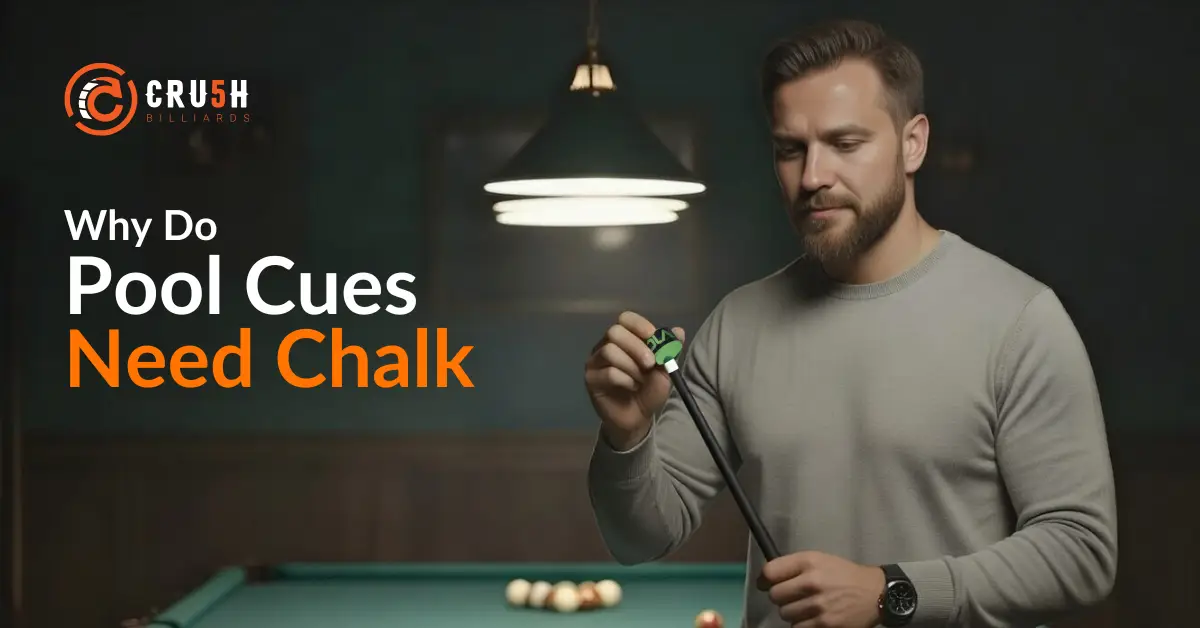
When watching experienced billiards players, you’ll notice a simple habit repeated before nearly every shot: chalking the cue tip.
But many beginners wonder:
Pool cues need chalk because it increases friction between the cue tip and the cue ball, preventing slips (miscues) and allowing players to apply spin, control direction, and execute accurate shots.
Without chalk, even the best cue stick would struggle to maintain proper contact with the cue ball.
In this complete guide, you’ll learn:
What pool chalk actually does
Why professional players chalk before every shot
How chalk improves spin and accuracy
The science behind cue tip friction
How to properly chalk a pool cue
How to choose the best chalk
If you’re serious about improving your billiards game, understanding pool cue chalking is essential.
You can also explore professional billiards gear and cues at Beer City Billiards
Pool chalk increases friction between the cue tip and the cue ball, helping players prevent miscues and apply spin. The chalk creates a slightly rough surface on the cue tip that grips the cue ball during impact.
When a cue stick strikes the cue ball, the contact lasts only a fraction of a second.
Without chalk, the smooth leather cue tip can easily slide off the ball, especially when hitting off-center.
This slip causes what players call a miscue.
By applying billiard cue chalk, players create a textured surface that grips the cue ball better during contact.
This improves:
Shot accuracy
Cue ball control
Spin application
Shot consistency
That’s why chalk in billiards is considered one of the most essential accessories in the game.
Many people assume chalk is simply a tradition in billiards, but the reality is grounded in physics.
When the cue tip hits the cue ball, the coefficient of friction determines how well the tip grips the ball.
Chalk particles fill tiny pores in the leather cue tip, creating micro-abrasions that increase grip.
This friction allows the cue tip to:
Stay in contact with the ball longer
Transfer spin
Maintain directional control
Without chalk, the cue tip would slide off the smooth cue ball surface, making precise shots extremely difficult.
Professional players almost always chalk their cue before shooting.
This habit isn’t just superstition.
Each shot removes a small amount of chalk from the tip, reducing friction over time.
Reapplying chalk ensures the tip remains properly coated.
Players chalk frequently because it:
Prevents miscues
Maintains shot consistency
Ensures optimal spin control
Even top professionals treat chalking as part of their shot routine.
A miscue happens when the cue tip slips off the cue ball.
This usually occurs when hitting the ball off-center.
Chalk prevents miscues by increasing friction.
Without chalk, off-center shots would almost always slip.
Spin is critical in advanced billiards strategy.
Players apply spin to control the cue ball’s movement after impact.
Types of spin include:
Backspin (draw)
Topspin (follow)
Left spin
Right spin
Combination spin
Without chalk, applying these spins would be extremely difficult.
Consistency is key in billiards.
Chalk ensures that each shot has the same level of friction between the cue tip and cue ball.
This helps players build reliable muscle memory.
Cue tips are made of compressed leather.
Repeated impact with the cue ball can smooth the tip over time.
Chalk helps maintain the tip’s rough texture, extending its lifespan.
Humidity and sweaty hands can affect billiards equipment.
Chalk absorbs moisture that might make the cue tip slippery.
This helps maintain consistent shot performance.
Chalking also plays a psychological role.
Many players use the chalking routine to:
Focus before a shot
Plan their next move
Maintain rhythm
It’s a small ritual that helps players stay mentally sharp.
Most billiard chalk is made from a mixture of:
Silica
Aluminum oxide
Coloring agents
These materials create an abrasive surface that increases friction.
Higher-quality chalk formulas adhere better to cue tips and produce less dust.
Many beginners apply chalk incorrectly.
Instead of stabbing the chalk cube, use a gentle rotating motion.
Hold the cue tip upward
Place the chalk lightly on the tip
Rotate the chalk evenly
Cover the entire tip surface
This method ensures an even layer of chalk and reduces waste.
Most experienced players chalk:
Before every shot
After applying heavy spin
When the cue tip looks smooth
Frequent chalking ensures the tip maintains optimal friction.
Not all pool chalk performs the same.
The most common chalk found in pool halls.
Affordable and effective for casual play.
High-end chalk brands offer improved adhesion and reduced dust.
These chalks often last longer and require fewer applications.
A cone-shaped design that allows easier application.
Some players prefer this style for better control.
When selecting chalk, consider:
High-quality chalk sticks better to the cue tip.
Low-dust chalk keeps tables cleaner.
Premium chalk lasts longer between applications.
You can find professional billiards equipment and accessories at: Beer City Billiards
In addition to chalk, serious players rely on several accessories.
A high-quality cue improves accuracy and control.
Explore professional pool cues:
Protect your cue during transport.
Chalk holders, tip tools, and cue maintenance gear help extend cue life.
Many players unknowingly misuse chalk.
Too much chalk can create dust and uneven contact.
This damages the chalk and wastes material.
Cheap chalk often falls off quickly and increases miscues.
Professional players follow simple habits:
Chalk lightly but frequently
Rotate the chalk evenly
Avoid tapping chalk on the table
Keep chalk clean
Small habits can make a big difference in performance.
Pool cues need chalk to increase friction between the cue tip and cue ball, preventing miscues and allowing players to apply spin and control shots.
Yes, but it greatly increases the chance of miscues and reduces shot accuracy.
Each shot removes chalk from the cue tip. Reapplying chalk ensures maximum grip for the next shot.
Higher quality chalk often sticks better to the cue tip and produces less dust.
Pool players chalk their cues to increase friction between the cue tip and cue ball, preventing miscues and improving spin control.
Yes, chalk is essential for maintaining grip and executing accurate shots.
No, but excessive chalk dust can accumulate on the felt and requires cleaning.
Chalk may seem like a small detail, but it plays a massive role in billiards performance.
By increasing friction between the cue tip and cue ball, chalk allows players to:
Prevent miscues
Apply spin
Control shot direction
Maintain consistency
Whether you’re a beginner or an experienced player, proper cue chalking is essential to improving your game.
For professional billiards gear, cues, and accessories, visit: Beer City Billiards